Showing posts with label Ford. Show all posts

Sunday, 25 January 2015

Nice work if you can get it


Received wisdom is that the best way to make a small fortune is to start with a large one.  Although usually cited as an example of people frittering away their wealth but it also conceals the truth that it takes money to make money.

Consider the cars people buy; ten years ago a ford Focus ST or Mondeo Turbodiesel for about £19,000.  Prices for the Focus today are in the region of £4-5,000, the Mondeo could be had for £1,000 or less.  That, as you’ve probably worked out, is £14-18,000 lost in depreciation if you bought new and kept the car all that time.  Although depreciation is non-linear it works out as costing at least £1,400 on top of the other running costs.

Contrast that with the 2005 Ferrari 575 Superamerica that sold at auction last week for $517,000, which works out at about £345,000.  The list price for the same car when it was new was £191,000 (or £198,800 with the F1 gearbox).  Rather than losing money that is an increase of £14,700 a year on average.  It might not be a large fortune but it is better than nothing.

Of course, to make that money you need to be in the position to buy the Ferrari in the first place.  You also need to choose your car wisely, if you’d gone for an ordinary Ferrari 575 you’d have saved about £40,000 initially but that car would only be worth £90,000 today (only!).  It also makes me wonder if anyone leased a 575 Superamerica and what the monthly payments are like on a car that is going up in value.

Saturday, 26 February 2011

News Roundup 25 February 2011

Last week it was all about the Geneva Motor Show with a heavy green tint. This week, to restore some balance, it is time to celebrate the fast, powerful and (more or less) British.

First came the news of a rejuvenated AC. In the tradition of the small sports car manufacturer AC seems to alternate between periods of great activity and times of total obscurity. Cars like the ME and the modern Ace have been released with a fanfare and then nothing much happens for a decade or so. Now AC is in the news again with a new “Cobra”.

Image Source

Not that it is called Cobra, or built in Thames Ditton (or Texas or Brooklands) and it doesn’t even have a Ford V8. The substitution of a Chevrolet V8 from the Corvette is in a way appropriate. Back in the mists of time the Cobra was originally intended to have the Chevrolet motor but General Motors would not play ball. Whether purists will accept a German made, Chevrolet powered AC remains to be seen.

Although everyone seems to want the look of the 7 litre Cobra - with the wide, curvaceous wheelarches – I prefer the less bulbous look of the earlier 260/289 small block cars. Maybe the range of classic AC cars to be produced at Brooklands will revive the more subtle shape.

Image Source

Compared with the big, brash AC to the new Morgan shows just how varied the British sports car can be. The new Three Wheeler represents the Malvern Link company returning to its roots. It is a light, low, simple, three wheel design with a V-twin engine exposed to the elements at the very front, a cabin that looks snug and not much else. The only thing I don’t like is the use of a car gearbox (from Mazda). It is probably a very good gearbox but I think a motorcycle gearbox would be even nicer to use – but it wouldn’t have a reverse gear which would probably be a serious drawback. Anyway, something as low, light and exposed as the Morgan should be enormous fun. I hope, one day, I can find out for myself.

Friday, 19 November 2010

A few photos from the NEC

A crowded NEC isn't the best place for photography so I didn't take many pictures. Here is a selection:


I had never seen a Citroen Bijou before so it was nice to see one; the best thing about car shows is the opportunity to see things you've never seen before. The Bijou was a Slough-built Citroen, based on the 2CV with a glassfibre body. Despite the 'lightweight' body it weighed more than the steel-bodied 2CV. Power, if you can call it that, came from a 425cc flat twin. You didn't know Citroen built cars in Britain? You do now.


This 1930s Ford V8 was very stylish. I think it was a 1934 car with just one or two owners from new. Power would have been 75bhp from a 3.6-litre, sidevalve V8.


Keeping with the transatlantic theme, this Buick was VAST and very brown. You can imagine it packed full of a typical American family and all their holiday (sorry, vacation) luggage.


The emblems on the brushed metal wheel trims were rather neat.


As was the ornate 'Estate Wagon' script, and you get an idea of the fake wood on the body.


More fake wood at the back.


An American Icon, the fins of a 1959 Cadillac convertible.


Finally; something British, although with a Japanese twist: a cutaway Rover 200. It is a little odd to see cars that I can remember being launched now appearing as classics. However, in its time this 200 was well regarded and looked very classy. It also shows that you don't need to own something expensive and impractical to participate in the classic car scene.

Tuesday, 19 October 2010

Moving Motor Museum

Being a bit of a transport geek I can’t resist either a heritage railway or a motor museum. Over the weekend I visited the Mid-Hants Railway or Watercress Line and the National Motor Museum, Beaulieu. Much as I love the Beaulieu museum I do wonder if motor museums could learn a thing from the steam railway.

From Beaulieu and Watercress Line

The great thing about these enthusiast-run railways is that you experience the trains running; not just as static exhibits. You get a flavour of what railway travel was like fifty years ago. It would be interesting to see the same model applied to cars.

Imagine a museum where some cars are in use either every day or, at least, at the weekends. The public could see and possibly even ride in old cars. To that end you’d need a short test track. Not a race track but somewhere with a variety of road surfaces, corners and gradients and maybe a long straight. Cars would not be pushed to their limits but I would want to give people an idea of acceleration, ride comfort and cornering; hearing the noise of the engines, the feel and smell of the upholstery.

What cars would go in the collection? You’d want cars that were interesting to look at and travel in.

Considering those factors the first cars I’d source for my collection would be:

From Model T Pictures

Ford Model T – A unique character with its strange controls.

From Haynes Motor Museum

Citroen SM – demonstrate the ride quality and general eccentricity of Citroen.

From BIMS 2008 Oldies

Lamborghini Countach – big on drama and spectacle whether in motion or standing still.

From Warwick Classic and Retro Cars

Mini Cooper – cramped and uncomfortable but fun.

From Gold Cup 2008

Jaguar XJ12/Daimler Double Six – Possibly the smoothest engine ever and a great ride too.

From Gold Cup 2008

Rolls-Royce Corniche – Or any Shadow variant, to sample Rolls-Royce craftsmanship.

From Luton Festival of Transport

Plymouth GTX – Feel the power of a big, American V8 as well as the comedy cornering behaviour of a car designed for straight roads.

What cars would you include?

Sunday, 9 November 2008

Watching Top Gear

I'm afraid I can't resist the charms of BBC television's Top Gear. Today they are testing the Dodge Challenger, which I have a massive soft spot for and seeing one on the move on the small screen just makes it look even more appealing. Actually seeing it is only half the story, hearing it is even bigger. It makes me wonder how the Challenger drives and how it would compare to the Ford Mustang. The 'stang was crude but both effective and entertaining but it did have competition suspension and incredible, racing brakes, not to mention a supercharged engine. Maybe I should drive one of the racing tuned Challengers that Chrysler offers in the USA only to people with racing licenses.

Friday, 29 August 2008

Weekend update Part 4

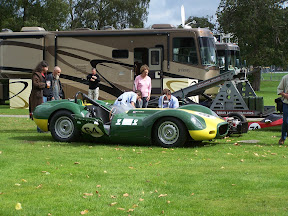
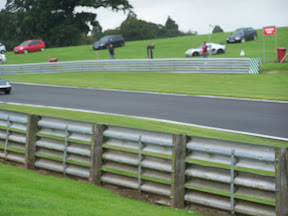
Time for a little light entertainment before the weekend. I am quite pleased with some of the photos I took at the Gold Cup. Static photos are quite easy to take but I’m particularly fond of this scene with a Lister Jaguar.


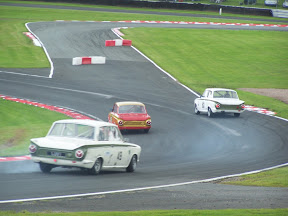
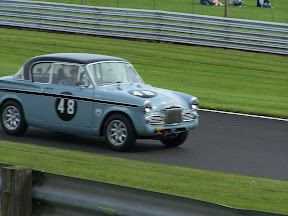
Action photos are more difficult. I know a poor workman blames his tools but action pictures don’t always focus in time and there is an annoying delay between pressing the button and the picture being taken – time that can make the difference between capturing the moment and missing it completely. One that did come out well was this scene of three Lotus Cortinas cornering hard at Cascades corner.


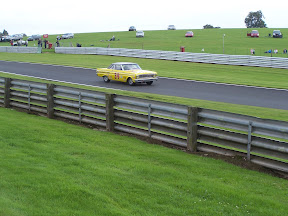
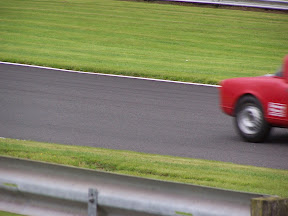
Sometimes the pictures were just a little too small or slightly out of focus. This picture of a Ford Falcon illustrates the problem.


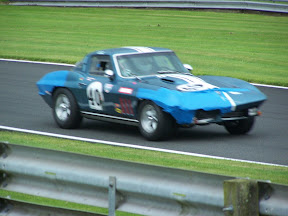
Even more depressing is the perfectly framed shot that is completely out of focus. This Chevrolet Corvette was an interesting subject as it had been hastily repaired after an accident, you can make out the blue “gaffer tape” but the detail is lost.


Then there are the photos that were taken way too soon…


… a little too soon …


or too late.


I can’t remember what happened here but it was probably quite dramatic given the smoke hanging in the air…


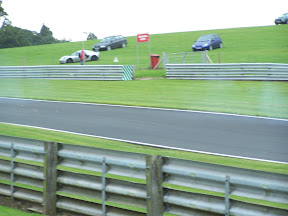
But sometimes, if you’re too slow on the button, all you get is a picture of an empty stretch of tarmac.

Tuesday, 22 July 2008

British International Motor Show 2008

What a day that was! There were some important lessons learned like, you can’t catch the 6:44 train to London if you leave my house at 6:28. I’ve also discovered that ExCeL is a long trek from London Marylebone and that there are no ticket barriers on the Docklands Light Railway.

More important, I’ve seen just how much hard work goes on getting the news from the motor show to the printed page or web site. I like to think I made my own contribution to reporting the news.

The big news was probably Lotus new 2+2 mid-engined car. For some reason Lotus hired a load of actors/models to dress up in identical suits and blank masks that hid their features, something about not being another face in the crowd. Whatever the reason it was very bizarre, like something out of Dr Who or a 1960s B-movie.

Other important stuff included the new Vauxhall Insignia, it looks smart and will probably sell well but it does seem like just another car – sorry Vauxhall. At the opposite end of the hall Ford was showing off the new Fiesta. Again, I’m not sure the Fiesta is a great leap forward but at least Ford have resisted the temptation to make it larger and heavier than the old Fiesta which represents some kind of progress.

What I found most interesting was the way Ford, Jaguar, Mazda and Land Rover occupied one end of the hall while Vauxhall, Chevrolet, SAAB, Cadillac and Hummer occupied the opposite end. I wonder whether the layout at the Ford end was selected before Jaguar-Land Rover was sold off to Tata? I also thought Vauxhall had the more elaborate and impressive show stand, with a giant iridescent partition wall and more Insignia than you could shake a stick at. By comparison Ford’s stand looked a little sparse and empty – sorry Ford.

Personal favourites: It was nice to see the Lexus LF-A and I can’t wait to drive it (come on Lexus, you’ve kept us waiting for too long). I also fell for the Morgan Life Car concept and both Hyundai’s rwd coupé and Kia’s Kee concept. In terms of cars you can actually buy, I found myself gazing fondly at the Chevrolet Epica – a firm favourite of a journalist friend. The trouble is there is so much to take in it all becomes a bit of a blur.

Is it worth going? That depends, if you’re a jaded and cynical motoring journo then you’ve probably seen it all before, read the press releases and forgotten half of it so there will be very little new stuff. If you want to see a variety of concept cars under one roof then it is a great place to go. There is also the opportunity to have a go in a Mazda or a Peugeot and to drift a Westfield. Children might be entertained by the characters from Disney-Pixar’s film Cars. And if you fancy a break from looking at cars there is a fine collection of motor boats and yachts moored outside.

Monday, 21 July 2008

Motor show ahead

The waiting is nearly over, tomorrow the British International Motor Show opens its doors to the press. What is more astonishing, for me at any rate, is the fact that I’ll be joining them.

I must admit I’m not usually the biggest fan of motor shows but press day should be a bit different. Plus there will be a fair few “firsts” at this show. I’m quite looking forward to having a closer look at the new Vauxhall Insignia and Ford’s latest Fiesta.

It even looks like I’ll have some work to do while I’m there. Don’t want to say too much but at least it should give the day a sense of purpose.

Saturday, 28 June 2008

Red letter day!

What a busy day, travelled down to Essex to drive a Ford Model T. Some things are worth making an effort to do and this was one of them. Although it was completely unlike anything I’ve ever driven it was (or could be, with practice) surprisingly easy to drive.

Just studying the Model T was an education. Here was a car that was not only affordable to buy but simple and robust. No need for specialist care – a competent blacksmith could probably make replacements for any metal part that broke. It is a world away from the elaboration of new cars and so much better for it.

Ford Model T

Monday, 31 March 2008

Cars in Books

To be a successful writer it is important - or so I have been told, more than once so there must be something to it – to read lots of books. Even if it wasn’t important I like to think I’d still try and find worthwhile reading material; there are few things as pleasurable as losing yourself in a good story.

My interest in cars does mean that I take notice whenever they appear in novels. Most people probably don’t notice but getting the details right helps to draw me into the story. Get it wrong and while, if the story is strong enough, I might not give up on the book I will feel somewhat disappointed. Mo Hayder’s thriller Birdman was a superb can’t-stop-turning-the-pages read. The only fly in the ointment was that one of the main characters drove a car identified as a Cobra. This Cobra was no stark, four-wheeled motorbike – it had air conditioning and electric windows. Any sort of winding windows are incompatible with the Cobra shape as devised by AC; there simply isn’t the space in the tiny doors for the window to wind into. Hayder must have been thinking of a different car.

Photobucket

To understand how to get it right you need to get hold of an Ian Fleming. Perhaps not every detail was technically correct but I cannot recall any serious inaccuracies. What he did well was to give a sense of pace and urgency to what was necessarily a lengthy piece of writing when describing a car chase. The most memorable chase was in Moonraker; Bond, in his grey, 4 ½ litre supercharged Bentley, pursued the villain, Hugo Drax, through London and down to Dover in order to rescue the girl (unconscious on the back seat of Drax’s Mercedes 300S) and save the day. At one point an Alfa Romeo 8C 2300 intrudes on the action, you could practically hear the crackle of the Alfa’s exhausts and the whine of the supercharger.

Mercedes 300S
Picture from www.sleepingbeauties.com.au

Thomas Harris, author of Silence of the Lambs, does a much better job. In Red Dragon cars were fairly generic as the narrative focussed on the actions and interactions of the characters. By the time Silence of the Lambs was written Harris indulged in a little more detail; Clarice Starling drove a worn out Ford Pinto, just the sort of car you’d expect a poor student to be driving. In his latest novel, Hannibal Rising, there was a sense of even greater understanding – at one point the young Hannibal Lecter is driving a borrowed van through a rainy Paris evening. To effectively clear the windscreen he had to keep lifting off the accelerator as the wipers worked off inlet manifold vacuum (which causes the speed of the windscreen wipers to slow down as the accelerator pedal is pressed down). It was such an obscure detail, I was deeply impressed to see it used.

Monday, 17 December 2007

Number crunching

The British digital television channel “Dave” shows, amongst other things, repeats of the BBC’s motoring program Top Gear. I was watching one of the repeats today, the episode where a Bugatti Veyron and a Cesna light aircraft race across Europe. The Veyron has a power gauge to show how much power is being used at any given point. The presenter observed that at 80mph the Veyron needed only 50 of the 1,000 or so bhp to move it along.

It made me think; 50bhp isn’t a huge amount of power but is it more or less than ordinary cars need for a typical motorway cruise?

Exact figures are hard to come by but I looked at a selection of cars with about 50bhp and also with top speed around 80mph. The Chevrolet Matiz has 50bhp and can do 90mph; the Fiat Panda 1.1 has 54bhp and can do 93mph. You have to go back many years to find cars with top speeds in the 80mph range. In 1966 a Ford Cortina needed 63bhp to do 82mph; by 1970 a Hillman Avenger could manage 81mph on 53bhp although the Citroen GS looks like it was ahead of its time by doing 93mph on 55bhp.

I’m not sure if this proves anything except that it takes less power than you’d think to drive at motorway speed.

Friday, 9 November 2007

Classic Motor Show 2007

Although I don’t go to lots of classic car shows throughout the year I try never to miss the annual Classic Motor Show at the NEC, just outside Solihull (it is misleading to refer to the NEC, Birmingham). It fills four of the NEC’s exhibition halls and attracts a variety of clubs and dealers who all do a great job of bringing along interesting machinery. Apologies for the lack of pictures but I’ve never managed to take decent pictures at one of these shows.

A personal favourite was the Bristol Owners Club who brought along the 406S - a special, short-chassis version of the 406 saloon with bodywork in the style of the Bristol 404 (there was a 404 next to it for comparative purposes and an early 411 at the back of the stand looking as sober, purposeful and handsome as only a 411 can). The 406S was one of two short-chassis 4060s made by Bristol – the other receiving a low, 2-seat body by Zagato.

Other favourites included a 1969 Plymouth Road Runner on the Classic American magazine stand. As with most, if not all, cars on display it was spotlessly clean and beautifully presented; a beautiful example of one of my favourite muscle cars. Another big V8-powered coupe that I yearned for was a stunning 2-tone Rover 3.5 litre coupé otherwise known as the P5B.
Photo Sharing and Video Hosting at Photobucket
It is the interior and dashboard of the P5B that I particularly love although the styling and engine are good as well.

If you wanted to wallow - or just take a quick dip - in nostalgia the show is a good place to do so. I saw a Mk1 Ford Fiesta like one owned by my parents and a yellow Mk1 VW Golf like the one owned by my best friend’s family. So many memories of childhood days out…
Photo Sharing and Video Hosting at Photobucket

That was one of the nicer things about this show; it was nice to see basic models not just the sporting or luxury variants of popular cars. Everyone knows about the Talbot Sunbeam Lotus but I had forgotten about the 1.0 litre basic version (and how basic it is). Ford Capris were well represented and while the 3 litre and 2.8injection models were well represented there were also lesser 1.6 and 2-litre versions – including a 2 litre V4 mark 1. How simple, basic and insubstantial those popular old cars seem now. Conversely, are new cars overstuffed and un-necessarily complicated?

Another nice thing to see was interesting details that I’d not previously noticed. There was a Citroën GS and I realised that the radio was between the seats and the handbrake was on the dashboard. I admired the woodwork instrument pod of the Mercedes-Benz 600 and 220SE coupe. I had forgotten how small and neat the Suzuki SC100 is and I still don’t know why but I do think the FD-series Vauxhall Victor is an incredibly handsome car.

Photo Sharing and Video Hosting at Photobucket

Thursday, 11 October 2007

Autumn Time

Photo Sharing and Video Hosting at Photobucket

The season of mists and mellow fruitfulness is upon us, which means it is time for the annual European Car of the Year contest. Voted for by a jury comprising of 58 members from 22 countries, the number of jurors representing each nation depends on the size and significance of the motor industry and new car market in that country. Each juror has 25 points to award to at least 5 of the seven finalists. No more than 10 points can be awarded to any one car and ties are not permitted. Furthermore each juror must provide a written justification for the way they voted.

Photo Sharing and Video Hosting at Photobucket

The shortlist for the 2008 ECOTY has been released. From 35 eligible cars seven have shown the “right stuff” as potential Car of the Year material. Those cars are the Fiat 500, Ford Mondeo, Kia Cee'd, Mazda 2, Mercedes-Benz C-class, Nissan Qashqai and the Peugeot 308. Picking a likely winner from that lot is incredibly difficult. The Ford and Fiat are both highly regarded and both marques have a strong history of COTY winners. Only once, in 2005 when the Toyota Prius won, has a car built outside Europe been the outright winner – so it is unlikely that the Mazda 2 will win. Mercedes have only enjoyed one COTY win and nothing I’ve read about the C-class suggests that it could beat the Fiat of Ford. The Nissan might suffer because it looks like the sort of car we are supposed to hate – a SUV – or profit because it doesn’t fit typical classifications. The Peugeot will do well with the French judges but probably not any others where as the Cee’d could do surprisingly well.

Photo Sharing and Video Hosting at Photobucket

I think this is the strongest COTY line-up in years. Only the Peugeot 308 and Mazda 2 seem incongruous – the Lexus LS and Land Rover Freelander might have been more interesting finalists but possibly not consonant with the spirit of the time. My prediction is that the Fiat 500 will win, the Mondeo will be second and it will be close for third place between the Mercedes C-class and the Kia Cee’d. Kia challenging Mercedes, who could have predicted that?

Photo Sharing and Video Hosting at Photobucket

Saturday, 3 March 2007

In Retrospect – a snapshot of the cars of 2006

To the best of my ability I can remember 10 different cars from 2006. Not all of them were new, half were old cars borrowed from friends or used-car salesmen. The oldest car was 19 years old and the newest “old” cars had seen nine summers. At the start of the year, however, I was driving a car 16 years old. This was my cherished Honda Prelude, a 2.0i 16V 4WS model with leather seats and automatic transmission. It was beautiful to drive, great to travel in and – until the fateful day when it failed – faultlessly reliable. Sadly it did fail and repairing it was not viable so I salvaged the seats, sound system and special alloy wheels. The rest I watched being towed away; it was not a great start to the year.
Photobucket - Video and Image Hosting

After an awful, car-less week (frantically searching the used car classified ads) I found a Citroën BX19 (the 19-year old car). It was an unwanted trade-in at a local Ford dealer at a giveaway price and it was basically sound. I always admired Citroën engineering and this was a great opportunity to experience it first hand. The BX even had automatic transmission; I can manage 3 pedals and synchromesh but I prefer a “slushbox” when given the choice. It would be too much to expect something equal to Honda’s superlative engines and transmissions; the Citroën’s engine felt weak and the gear ratios odd but the BX was a relaxing drive. Nor could the BX hope to match the Prelude in the quality of its steering but the ride quality and brakes impressed me from day one. As the year progressed I positively delighted in the brakes; responsive to the slightest touch and with great reserves of stopping power. The suspension with its self-levelling ability to carry heavy loads and height adjustability to aid loading proved its value through the year. For all its apparent complexity the BX is a supremely practical car.
Photobucket - Video and Image Hosting

There was another Prelude, the same year and model as the one that started my year, the only difference was the 5-speed manual transmission. I hoped it might substitute for the car I lost but for many minor reasons it simply was not good enough and I sold it on again.

Shortly after buying the second Prelude (actually my 3rd but that story will have to wait) the first new car of the year came my way. It was the high performance ST version of the Ford Focus. None of the previous Foci to come my way impressed me so my hopes were not high for this one. Maybe it was my low expectations but the ST seriously impressed me. The Volvo-derived 5-cylinder turbocharged engine was a delight, the 6-speed manual transmission could be enjoyed or ignored as circumstances dictated and it felt incredibly surefooted. Not only that but the ST could be sweet and refined, it was at home trickling through town or loafing up the motorway as it was charging up a twisting hill. The Focus ST displayed an uncommon touch of class and the memory of my drive will take a long time to fade.
Photobucket - Video and Image Hosting

Another car that could speed effortlessly uphill was the Lexus coupé, also known as the Toyota Soarer. Soarer is a good name; it perfectly describes the way this elegant car moves. It is a complicated car, with numerous switches labelled with obscure acronyms or Japanese characters. Setting the radio or air conditioning without being shouted at in Japanese was a tricky business. At least the basic controls were straightforward, with little skill and less effort the Soarer could cover the ground quickly in great comfort and security. No other car in my experience offered such great reserves of overtaking ability. The only problem was giving it back to its rightful owner.

The simplicity of the VW Urban Fox was a stark contrast to the elaboration of the Lexus. It may have had 5 fewer cylinders and roughly 200 less horsepower but the VW was, in its own way, every bit as satisfying as the Lexus. My only objections to the Fox is that it is not a small car; but since it was never intended to be small only cheap my objection is rendered invalid; and the way the windscreen pillars obscured the view, but every new car seems to suffer the same problem. To VW’s credit the Fox does not feel cheap, all the basics are there, it is reasonably lively, tolerably refined and the ride and handling are nicely judged. No car (except perhaps my Citroën BX) impressed me with the breadth of ability available for so little money.

For all the Fox’s sensible qualities I found the 1999 Honda Prelude 2.2 VTi rather more enticing. A friend was thinking of buying the Prelude and as the local expert in all things Prelude I selflessly offered my services to evaluate it. It felt like a dream, the V-tec engine married superbly to the 4-speed automatic transmission, the electronic 4-wheel steering was subtle yet brilliant and the refinement, comfort and smoothness were an unexpected bonus. My friend decided against the Prelude and my only regrets were that I did not have more time with it and that I could not afford to buy it myself.
Photobucket - Video and Image Hosting

The Prelude started a short run of Hondas; there was an intriguing Accord 2.4 with lane following steering and distance keeping cruise control. Judged within the terms of what they are supposed to do the systems worked very well. As an aid to the frequent motorway driver they might even be useful. Even now I am unsure whether such driver aids are a desirable use of technology. Aside from that the Accord was perfectly good if unremarkable car, the automatic transmission was better for having 5 ratios and the engine was – if only theoretically – worse for not having 6-cylinders. The most memorable moment in the Accord was the abashed reaction of the man from Honda when a friend of mine claimed the ride “wasn’t bad”. The man from Honda breathed a sigh of relief when it turned out that my friend’s benchmark was his Series 3 Jaguar XJ6.
Photobucket - Video and Image Hosting

The other Honda was a Civic 2.2CDTi. I admired the Civic’s styling and interior but I was severely disappointed by Honda opting for Macpherson struts at the front and a torsion beam axle for the rear suspension. Ten years ago Civics rode on double wishbone suspension all round; as the styling has advanced the underpinnings appear to have regressed. At least evidence of progress could be found under the bonnet. Here was a diesel engine that did not feel, sound or perform like a diesel; maybe one day I will find one that I do not find objectionable. It is a shame that the rest of the Civic does not feel as bold and clever as the styling.

It is slightly sad to reflect that the Citroën C6 does not feel quite as bold and clever as a Citroën should. At least by any other standards it seemed pretty astonishing. I was interested in the suspension geometry so, abandoning all mechanical sympathy, I swung the wheels onto full lock while the car was parked. I wanted to see if the camber of the front wheels changed as the front wheels steered. The wheels remained perpendicular to the road and I was pleased; the Citroen CX, which has been identified as the C6’s spiritual predecessor, enjoyed similarly pure geometry. The CX never enjoyed the roll-free cornering that makes the C6 so extraordinary. In high winds and on twisting roads it felt incredibly composed and surefooted. I was disappointed that the brakes did not match those on my BX for response but that is what you get when you swap high-pressure hydraulics for a conventional brake servo. The creeping, dead hand of convention seemed ever present in the C6 and yet the more I think about it the more favourably I view the Citroën. I remember the ride, the poise, the refinement and the superb interior. More than any other new car I drove last year the Citroën felt modern.
Photobucket - Video and Image Hosting

The best thing about last year’s cars was the sheer variety offered. Every car demonstrated something of interest, which is what every critic wants; there is nothing worse than the car about which nothing can be said. And it was a relief not to encounter a bad car; if only the same was true every year.