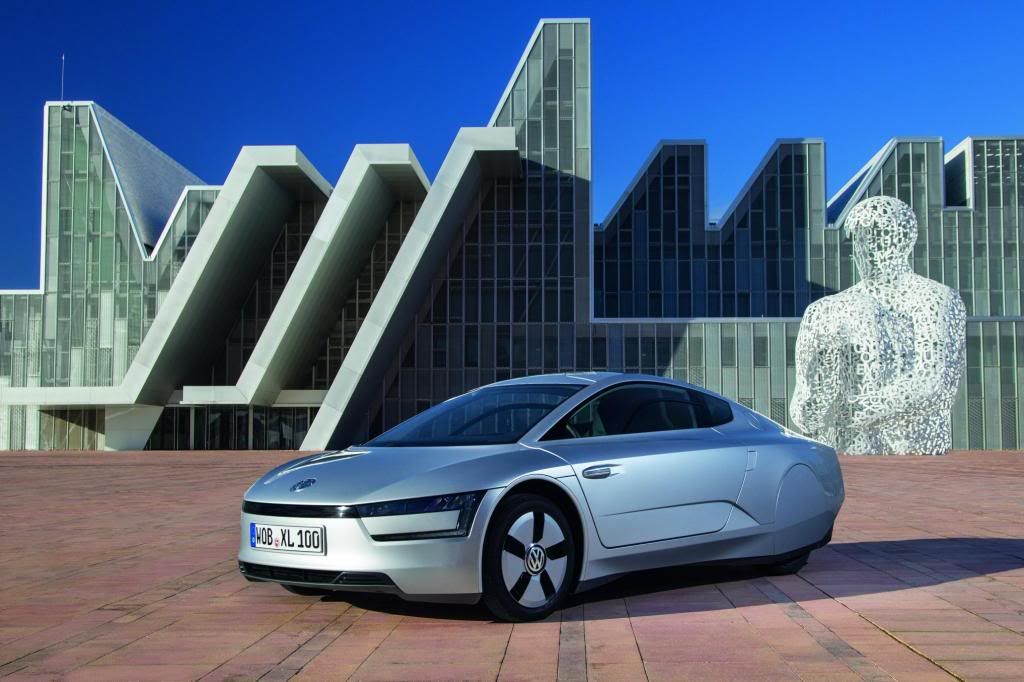
Every so often a car comes along that just seems "right". The Volkswagen XL1 is one of those cars; mainly because it is low, sleek and compact - a perfect antidote to most of today's bloated machines. What's not to like about a low, light, wind cheating, mid-engine coupé? I don't necessarily go along with the use of complex machinery to chase fuel saving and cut trivial emissions but I hope driver enjoyment hasn't been forgotten in the pursuit of 314mpg. It would be a terrible waste to build a low, light, mid-engine car that wasn't fun to drive.
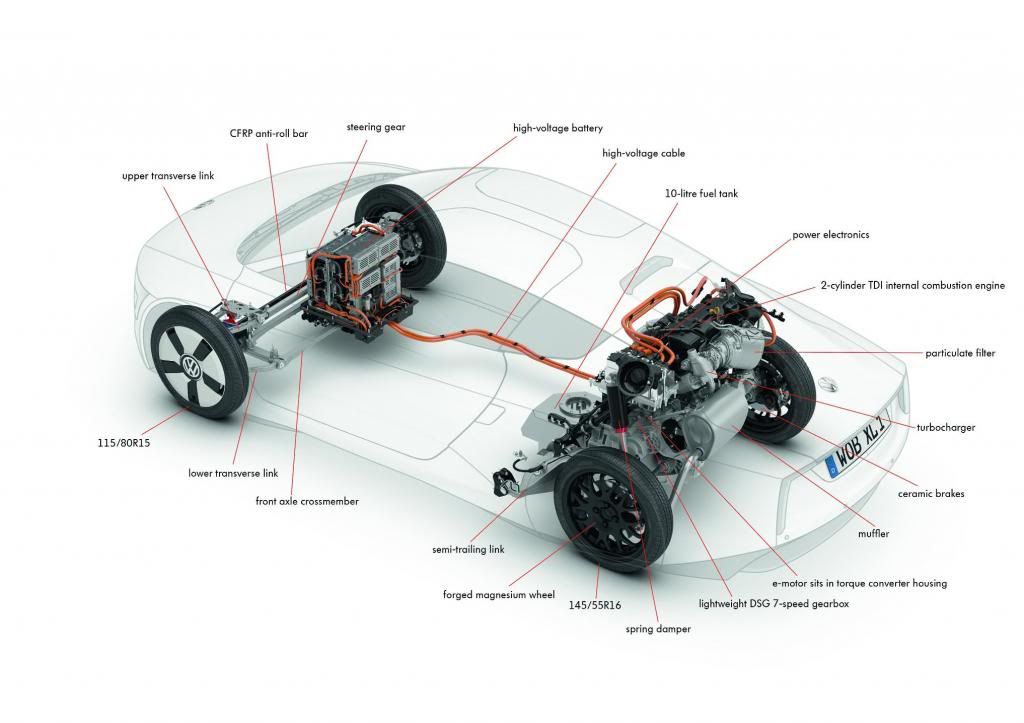
When I first saw it the XL1 seemed familiar, the shape reminded me of the Pininfarina Ethos II concept car. Perhaps it is not surprising, the dimensions are similar and both had low-drag, mid-engine bodywork. Under the smooth skin both had two-cylinder engines although the Ethos II was two-stroke, the XL1 is a diesel hybrid.
The diesel engine in the XL1 worries me. How responsive can a two-cylinder turbodiesel be? VW's forced-induction diesel engines can punch hard once they get going. Frustratingly they also suffer from a noticeable time delay between calling for power and the engine delivering the goods. Maybe the car's low weight and the presence of an electric motor will mask the effect.
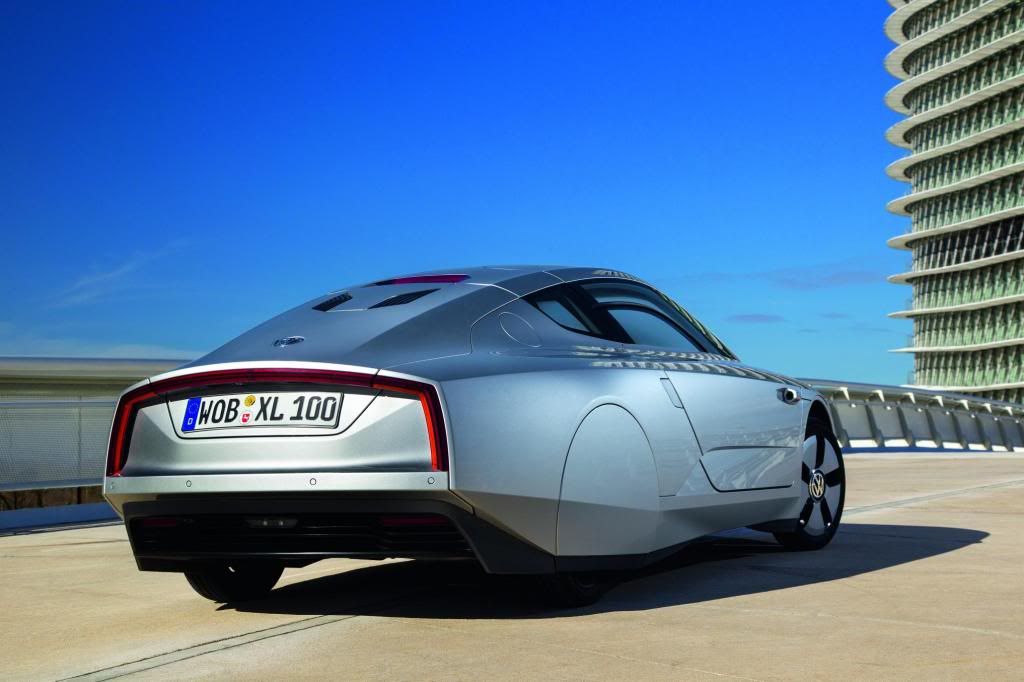
The other thing that worries me is the choice of tall, slender tyres. Yes, a 145/55-16 tyre will cause very little aerodynamic drag and minimal rolling resistance in a straight line, but in the real world I think drivers would be better served by something wider, lower profile and on smaller diameter wheels. Will the XL1 end up with an over-nannying electronic stability system to compensate for the poor choice of footwear?
I know, I know, I want the XL1 to be something that it was never intended to be. But why can't we have cars that are frugal, fleet footed and fun?
Showing posts with label economy. Show all posts
Saturday, 23 February 2013
Car of the Day - VW XL1
Labels:
diesel,
economy,
ethos,
hybrid,
Pininfarina,
two stroke,
Volkswagen,
VW,
XL1
Tuesday, 6 May 2008
A blast from the past #3
Two speed supercharging.
There is, as the popular saying would have it, nothing new under the sun. So when I read a press release from Antonov Automotive Technologies proclaiming 2-speed superchargers the way forward I recalled that the idea has been tried on piston-engined aircraft. In aviation the idea was to maintain performance at altitude so as the aeroplane climbed the pilot would select a gear to speed up the supercharger. It was a crude but reasonably effective way to compensate for the thinning of the air.
A supercharger is an air pump and while different types have different characteristics but, broadly speaking, the faster it runs the more air it moves. Antonov’s idea is to run the supercharger relatively faster at low engine rpm to boost low-speed torque without blowing the engine up at high speed. They don’t say this, of course, but that is what it amounts to. The behaviour of the supercharger should be fully automated and imperceptible when driving. The goal is to allow vehicle manufacturers to use smaller engines that are more economical.
I’m not sure how plausible their claims are. Superchargers are not the most efficient means of increasing performance. I’m not convinced by anyone who claims that superchargers don’t have the heat issues of turbochargers. Anyone who has used a bicycle pump knows that compressing air makes it hot, the air isn’t particularly bothered how it gets compressed. Two-speed supercharging is an interesting idea but I wonder when engineering fashion will swing back towards big, engines in low states of tune combined with high gearing – the sort of thing seen with the BMW 525e and Renault 5TS.
There is, as the popular saying would have it, nothing new under the sun. So when I read a press release from Antonov Automotive Technologies proclaiming 2-speed superchargers the way forward I recalled that the idea has been tried on piston-engined aircraft. In aviation the idea was to maintain performance at altitude so as the aeroplane climbed the pilot would select a gear to speed up the supercharger. It was a crude but reasonably effective way to compensate for the thinning of the air.
A supercharger is an air pump and while different types have different characteristics but, broadly speaking, the faster it runs the more air it moves. Antonov’s idea is to run the supercharger relatively faster at low engine rpm to boost low-speed torque without blowing the engine up at high speed. They don’t say this, of course, but that is what it amounts to. The behaviour of the supercharger should be fully automated and imperceptible when driving. The goal is to allow vehicle manufacturers to use smaller engines that are more economical.
I’m not sure how plausible their claims are. Superchargers are not the most efficient means of increasing performance. I’m not convinced by anyone who claims that superchargers don’t have the heat issues of turbochargers. Anyone who has used a bicycle pump knows that compressing air makes it hot, the air isn’t particularly bothered how it gets compressed. Two-speed supercharging is an interesting idea but I wonder when engineering fashion will swing back towards big, engines in low states of tune combined with high gearing – the sort of thing seen with the BMW 525e and Renault 5TS.
Labels:
Antonov,
blast from the past,
economy,
performance,
supercharger,
turbo,
two-speed
Tuesday, 2 October 2007
More Torotrak News
Another press announcement from Torotrak, this time slightly more relevant to the real world. A bus fitted with a prototype Torotrak IVT transmission demonstrated a 19% improvement in fuel economy compared with the standard 5-speed automatic transmission.

The bus, an Optare Solo 60-seat vehicle, was fitted with a Torotrak IVT transmission and run through the Millbrook London Transport Bus cycle at the Millbrook test facility in Bedfordshire. It is an intensive stop-start cycle, which sounds like it should make the highest demands on any vehicle on the test.
Torotrak seem to think that with a purpose built transmission the gains could be even higher. Optare are, apparently, interested in putting the IVT into production. I would imagine that if the transmission can be incorporated at minimal additional cost the bus operators would be keen on the potential reduction in operating costs.
The bus, an Optare Solo 60-seat vehicle, was fitted with a Torotrak IVT transmission and run through the Millbrook London Transport Bus cycle at the Millbrook test facility in Bedfordshire. It is an intensive stop-start cycle, which sounds like it should make the highest demands on any vehicle on the test.
Torotrak seem to think that with a purpose built transmission the gains could be even higher. Optare are, apparently, interested in putting the IVT into production. I would imagine that if the transmission can be incorporated at minimal additional cost the bus operators would be keen on the potential reduction in operating costs.
Labels:
Bus,
economy,
Environment,
fuel,
IVT,
Millbrook,
Optare,
Torotrak,
transmission
Monday, 26 March 2007
Taking it easy
According to the government every motorist should do their best to save fuel. They have even issued advice on how to drive in a fuel-saving manner. Some of the advice is good, sensible stuff; check your tyre pressures, don’t carry un-necessary weight, remove your roofrack if you don’t need it and try to plan ahead to avoid heavy braking. Other stuff is just plain nonsense; you expect governments to tell you to stick to the speed limit whether there is a good reason or not. Even stranger was the advice to change up at no more than 2,500 rpm in petrol cars and 2,000 in diesels. How that advice can be considered right or sensible for all cars escapes me.
In the spirit of enquiry I thought I would try and practice my own economy driving technique. Because my car has automatic transmission and an old-fashioned carburettor with a stiff linkage economy is not its forte. The very worst economy I ever had was 18mpg, when the fuel-air mixture was way out. I have seen this improve to 25 and then 30mpg as I’ve had work done to repair the carburettor. It is telling that the government does not remind us to have our cars tuned up regularly – a telling sign that most cars now have engine management systems that never need tuning.
As for economy driving, my aim is to drive economically with the minimum sacrifice in journey time. One of the most effective techniques, I hope, has been trying not to stop wherever possible – a technique that is good for journey times as well as economy. It requires careful observation, planning, timing and nerves of steel. I always err on the side of caution, however, so the economy benefit might not be what it could be.
The result of my careful driving; so far the fuel economy has increased to 31mpg, which hardly seems a worthwhile return for all the effort. It was disappointing because I had expected more; the needle on the fuel gauge was only just past halfway where I would have expected it to be on the ¼ mark. Whether you agree with saving fuel or reducing CO2 emissions there is no doubting the benefit of easing a few more miles out of a tank and, therefore, making the pound in your pocket go further in every sense.
In the spirit of enquiry I thought I would try and practice my own economy driving technique. Because my car has automatic transmission and an old-fashioned carburettor with a stiff linkage economy is not its forte. The very worst economy I ever had was 18mpg, when the fuel-air mixture was way out. I have seen this improve to 25 and then 30mpg as I’ve had work done to repair the carburettor. It is telling that the government does not remind us to have our cars tuned up regularly – a telling sign that most cars now have engine management systems that never need tuning.
As for economy driving, my aim is to drive economically with the minimum sacrifice in journey time. One of the most effective techniques, I hope, has been trying not to stop wherever possible – a technique that is good for journey times as well as economy. It requires careful observation, planning, timing and nerves of steel. I always err on the side of caution, however, so the economy benefit might not be what it could be.
The result of my careful driving; so far the fuel economy has increased to 31mpg, which hardly seems a worthwhile return for all the effort. It was disappointing because I had expected more; the needle on the fuel gauge was only just past halfway where I would have expected it to be on the ¼ mark. Whether you agree with saving fuel or reducing CO2 emissions there is no doubting the benefit of easing a few more miles out of a tank and, therefore, making the pound in your pocket go further in every sense.
Subscribe to:
Posts (Atom)