Showing posts with label MG. Show all posts

Thursday, 28 August 2008

Weekend catch up part 3

Time to cover some of the highlights of the Gold Cup weekend. One of my favourite things about the Gold Cup is the support from local classic car clubs who bring all manner of interesting machinery. I failed to photograph a very tidy chrome-bumper Alfa Romeo Alfasud but whoever owns it deserves a medal for keeping it in such great condition.

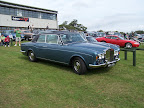
To start with, the Rolls-Royce enthusiasts club gathered some lovely cars, including a good many series-1 Silver Shadows but my heart was more taken by this Corniche.


If you prefer older cars there was this lovely Thrupp and Maberley 20/25 saloon.
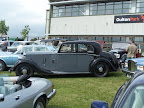


It looked imposing although I noticed a distinct lack of rear-seat leg room. This is certainly not a R-R in which to be chauffeured. Even more interesting was this Silver Cloud.
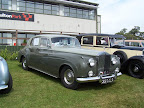


According to the notice in the window this was a development vehicle and had been fitted with an experimental V8 engine (although I believe it now has the production V8).

It wasn’t just Rolls-Royces, Bentleys were well represented too. I think this is an S-series Bentley Flying Spur Continental but I’ve never seen one with suicide rear doors before.
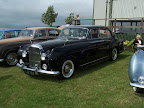


My favourite Bentley was this one.
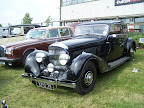


Not sure what model it is but I love the lines of this two-door coupé. I’m not sure I have captured its best angle but the cars were so tightly packed it was difficult to get back far enough to line up the photos – especially as I didn’t want to risk scratching someone’s pride and joy.

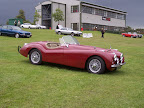
Lots of Jaguars turned up including plenty of XKs:
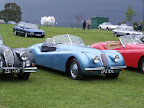


The last car was parked in the paddock rather than on open display. Whenever you go to a historic race meeting it is always worth having a look at the cars being prepared for racing, not only do you see interesting machinery like the Jaguar above but on the whole it is a friendly and relaxed place to be. Just remember not to get in the way of anyone working hard to prepare a car for racing.

Jaguars were also present on the track, including Peter Lanfranchi’s standard-looking Series-1 E-type and Steve Tandy’s Lightweight E.
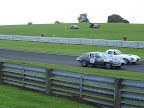


The lightweight E-types did very well in their race but smaller, lighter TVRs with big, American Ford V8 engines seemed to go faster.
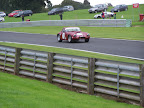


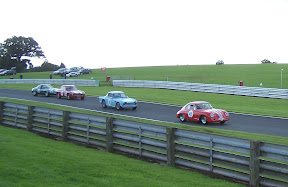
In fact plenty of almost prosaic machinery was giving the expensive stuff a run for its money. MGBs, for example, can go far faster than you’d think possible.
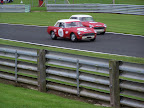


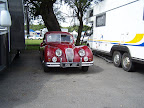
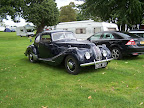
I hope this hasn’t been a pictorial overload; I’d like to finish with a personal favourite sighting. It is a Bristol 400 in very tidy condition but looking like a car that is used and enjoyed as it should be.
Tuesday, 26 August 2008

Weekend catch up Part 1

I spent the weekend up in Manchester with my friends Simon (of MG Midget fame) and Ally. What a wonderful weekend it was, catching up, chatting, messing about with Si’s sports car, enjoying tasty food and taking in some motor racing at Oulton Park.

Over the next few days I’ll try and post some of the photos I took of the racing and of the interesting cars parked on the hill overlooking Cascades. Before then I need to share a few observations:

1. The noise limit seems to have been tightened, some cars did not sound as ear-splitting or dramatic as I remembered from past years.
2. What happened to the pre-war cars? Last year there was some pretty good racing from the vintage and post-vintage crowd.
3. Where have all the Jaguars gone? The first Gold Cup meeting I attended had XKs, C-types and D-types racing but they seem to have deserted the Gold Cup.
4. Digital photography of moving cars can be a bit hit and miss. I promise to share some of the more amusingly bad examples.

I’ll leave you with this picture from practice for the Guards Trophy race.

Sunday, 30 March 2008

Of Instruments and Museums

Last weekend I visited my friend Simon, owner of the utterly charming MG Midget which I have mentioned before. Sadly, the Midget is not entirely well as you can read in Simon’s blog. But, component failure aside, the Midget did offer an interesting illustration of a phenomenon that is usually overlooked. Most cars, if they have a temperature gauge at all, only show you the engine temperature when the ignition is switched on. However, the Midget comes from a time before electrical transducers and has a mechanical temperature gauge, which shows the temperature even after you switch off the engine. When the engine stops the coolant pump and fan stop and the coolant just sits, picking up heat from the engine, with a mechanical temperature gauge you can actually watch the needle move towards the “H” marker. Wait long enough and the needle will drop back as the engine cools.

This weekend I visited the Coventry Transport Museum. As I may have said before, one of the reasons I like this museum is the way the exhibits are moved regularly so that there is always something new to see on each visit. The latest special exhibition is a celebration of anniversaries; the 60th anniversary of the Land Rover and Morris Minor and the 40th year of the Jaguar XJ6. It seems anniversaries only count if they are whole multiples of ten! There were some interesting substitutions among the exhibits. Using a Tygan Porsche 356 speedster recreation (developed, I believe from the famous Chesli Speedster) in place of a 1948 Porsche 356 was understandable, the Rover P4 in lieu of a 1958 P5 3-litre Rover was odd but the signage made it clear that it was only a temporary situation. No mention was made of the fact that the “Jaguar XJ6” was clearly an XJ12 series one (built in 1972-3 although Jaguar intended to launch the XJ with the V12 in ’68. Even more unusual was the presence of Daimler wheel trims (you would hope the museum could source the correct parts). Even so, it was a great exhibit even if it ignored the most meritorious 60-year old car, the 1948 Bristol 401.

Friday, 18 January 2008

Hard year’s drive 2007 Part 2

It was going to be an epic post to review all the cars I drove in 2007. For a blog format this didn't seem appropriate so I decised to break it down into several installments. Last time I looked at a couple of Vauxhalls. This time it is an unlikely pairing of Skoda and MG.

Skoda Roomster 1.4

The Skoda Roomster 1.4 was actually the first new car of the year. I wanted to like it; I admired the unconventional styling (particularly in the vivid blue paint of the test car) and the refreshingly colourful interior. Neither of those things could really be enjoyed while I was driving. What sparked my frustration was the way the door pillars blocked the view – a common problem with new cars. After that I noticed that there was more noise that I expected - at speed the engine felt as though it was revving its head off. On uneven roads the Roomster bobbed around as though the suspension couldn't cope. It should be said, however, that neither the ride nor the noise levels were any worse than in the Corsa.

The Skoda’s problem was that it was too tall, a criticism that couldn’t be levelled at the most entertaining car of the year; a 1972 MG Midget. Something so simple and even downright crude in places surely has no right to be such fun but it was refreshing to be able to look under a bonnet and be able to identify all the components within. It was great to have something so straightforward that I could fix it (or help to fix it) in someone’s back garden with about 3 tools. On the road it was sheer delight, for one accustomed to automatics getting used to the short-travel clutch was difficult. But the clutch pedal was an object lesson for all to copy – why does a clutch need more than an inch or two of movement? The gear lever was a delightful, mechanical, flick-switch affair; the engine was coarse but very charming; the brakes needed a big push (no servo?). The steering was pure delight, light and direct. Driving the Midget required skill and understanding but there was no substitute for the pleasure gained from getting it right.


To be continued ...

Wednesday, 5 September 2007

Weekend fun 2

Over the bank holiday weekend I helped my mate Simon with his MG Midget. You can read about what we did in Simon’s blog, he tells the tale far better than I could and I don’t see the point in repeating what he has already said.

On Sunday we took the Midget to watch the motor racing at Oulton Park (of which more anon). Simon was kind enough to let me drive the Midget back to his house (about 25 miles, I think). If you are under any illusions about how good a driver you are an old car will soon shatter them. Old cars are less forgiving of mistakes; they can be annoyingly literal in the way they respond to the driver’s inputs. Just trying to pull away in the Midget was challenging. I’m more used to automatic transmission and the last manual car I drove had a very forgiving engine and clutch. The Midget has a short travel clutch pedal and the initial throttle response feels a little all or nothing. Simon even confessed that for the first week or two he had the car he either stalled or shot off as fast as the car could go.

Once on the move the clutch seemed far more user friendly – one reason I dislike most manual transmissions is un-necessarily long-travel clutch pedals. The gear lever had a pleasantly mechanical action and no spring-loading (a pet hate of mine in 4-speed gearboxes) allowing the lever to be moved quickly and freely in all directions. It all feels slightly frantic, the Midget is very low-geared so you get to top (4th) very quickly and at 50mph I think the rev counter was showing 3,000rpm. All the intermediate gears make their own distinctive noise and there is no synchromesh on first gear, which means it will crunch if you are in the habit of selecting first while the car is moving (time to brush up on neglected double declutching skills). Actually slowing to a stop needs quite a push – there is no brake servo and certainly no Citroën-style high pressure hydraulic system to lend a hand.

What delighted me about the Midget was the steering. Even with a smaller than standard steering wheel - a lovely, leather rimmed Moto Lita wheel – the steering isn’t heavy. There isn’t much self centring action, which is just what I like, just wind lock on or off as necessary and the Midget changes direction immediately. Not that the steering calls for much winding as it is pretty direct. It is just as well, the Midget is a snug fit and there is no room for flailing arms.

Driving the Midget was a rare delight. There is something about a simple, fun to drive car that is incredibly appealing. You can drive it hard without endangering your license and learn a lot in doing so. You can maintain it at home without needing specialist tools or any great skill and without breaking the bank. One day I think I’d like to own a car like this.

Wednesday, 16 May 2007

Roadsters Remembered #1 MG MGB

Photo Sharing and Video Hosting at Photobucket

The British climate is not the most conducive to driving open cars but with summer on its way I’ve been thinking about all the open 2-seat cars I’ve driven. The MGB is more than just a car – it is practically a national institution. There is something about the B’s simplicity, size and good looks that give it enduring appeal.

There is no better way to see how cars have changed than to drive one that is 40 years old. It is a physical car; the steering is heavy, the pedals demand firm inputs, the ride is restless and there is persistent background noise. You get used to carrying a can of WD40 to spray on the engine when the weather is wet – otherwise it won’t start – and the fact that the rain will find somewhere to come round the edge of the convertible roof.

Old virtues also emerge, the steering is also more direct than a new car, the gear lever feels pleasantly mechanical and there is overdrive to get used to. Overdrive was a way to give 4-speed cars a 5th gear for relaxed high-speed cruising and on the B was operated by a switch on the dashboard. When it worked there was something wonderful about flicking a switch to change gear – but there was no guarantee of an instant response or even any response at all. Overdrive units have a tendency to get sticky with age.

What the MG needs to be enjoyed at its best are the right kind of roads; lightly trafficked, country roads. Do not try to drive as quickly as possible, you will expend a lot of effort for little reward and it is better to relax, enjoy the view and the beat of the exhaust. Repeat the exercise at night; the view may be diminished but the sounds and smells are enhanced. If you are used to closed cars it lends a whole new dimension to driving.

You may not want to do it all the time but driving an MGB is something you should try at least once.