I know my trusty Citroën BX will not last forever and the prospect of promotion at work has set my mind to thinking of buying a different car. Watching the historic motor racing at Oulton Park last weekend and a passenger ride in a friend’s MG Midget has left me hankering for a classic.
A Midget probably wouldn’t do, I would like something that is capable of sustaining a decent motorway cruising speed and that I can drive for a couple of hours at a time. Although I don’t need to use a car for commuting I would need something happy to live outside in all weathers that could be used every weekend without demanding too much maintenance. Such maintenance as is required should not be so complex as to be beyond my modest mechanical ability, nor too expensive if I ask others to carry it out. Other practical considerations should, I suppose, include reasonable fuel consumption – ideally no worse than 20mpg. Emotional considerations, for want of a better expression, are that I would like something good to drive. A decent turn of speed would be good but not necessarily essential; what is more important is tactility; steering that is slop-free, accurate and if possible high-geared; similarly I’d like a gear lever that moves with slickness and speed, ideally controlling a well-spaced set of ratios; pedals should be well-spaced for heel-and-toe action and hopefully not needing either excessive pedal travel or undue effort. I’d also like something stylish – foolish, I know.
I imagine a two-litre Bristol would be perfect; sadly, such things are beyond my pocket and possibly require more specialised care and attention than I could give. Only one car in my experience has come close to meeting my requirements; the MGB roadster. I don’t think I’d want a roadster, a GT would be better for my needs, leaving only a few doubts about whether I could cope with just two seats. Other possibilities I have considered, without knowing if they are sensible or not, are the Triumph GT6 and Volvo Amazon.
There are two questions I need to answer. Firstly, is it a mistake to subject a classic to the sort of treatment I’d give it; i.e. using it twice a week whilst keeping it outside when not in use? Secondly, what cars would you suggest, given a notional budget of about £2,000?
Showing posts with label MGB. Show all posts
Showing posts with label MGB. Show all posts
Sunday, 31 August 2008


Tuesday, 26 August 2008
Weekend catch up Part 1
I spent the weekend up in Manchester with my friends Simon (of MG Midget fame) and Ally. What a wonderful weekend it was, catching up, chatting, messing about with Si’s sports car, enjoying tasty food and taking in some motor racing at Oulton Park.
Over the next few days I’ll try and post some of the photos I took of the racing and of the interesting cars parked on the hill overlooking Cascades. Before then I need to share a few observations:
1. The noise limit seems to have been tightened, some cars did not sound as ear-splitting or dramatic as I remembered from past years.
2. What happened to the pre-war cars? Last year there was some pretty good racing from the vintage and post-vintage crowd.
3. Where have all the Jaguars gone? The first Gold Cup meeting I attended had XKs, C-types and D-types racing but they seem to have deserted the Gold Cup.
4. Digital photography of moving cars can be a bit hit and miss. I promise to share some of the more amusingly bad examples.
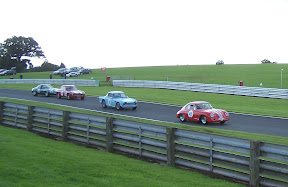
I’ll leave you with this picture from practice for the Guards Trophy race.
Over the next few days I’ll try and post some of the photos I took of the racing and of the interesting cars parked on the hill overlooking Cascades. Before then I need to share a few observations:
1. The noise limit seems to have been tightened, some cars did not sound as ear-splitting or dramatic as I remembered from past years.
2. What happened to the pre-war cars? Last year there was some pretty good racing from the vintage and post-vintage crowd.
3. Where have all the Jaguars gone? The first Gold Cup meeting I attended had XKs, C-types and D-types racing but they seem to have deserted the Gold Cup.
4. Digital photography of moving cars can be a bit hit and miss. I promise to share some of the more amusingly bad examples.
I’ll leave you with this picture from practice for the Guards Trophy race.
Wednesday, 5 September 2007
Weekend fun 2
Over the bank holiday weekend I helped my mate Simon with his MG Midget. You can read about what we did in Simon’s blog, he tells the tale far better than I could and I don’t see the point in repeating what he has already said.
On Sunday we took the Midget to watch the motor racing at Oulton Park (of which more anon). Simon was kind enough to let me drive the Midget back to his house (about 25 miles, I think). If you are under any illusions about how good a driver you are an old car will soon shatter them. Old cars are less forgiving of mistakes; they can be annoyingly literal in the way they respond to the driver’s inputs. Just trying to pull away in the Midget was challenging. I’m more used to automatic transmission and the last manual car I drove had a very forgiving engine and clutch. The Midget has a short travel clutch pedal and the initial throttle response feels a little all or nothing. Simon even confessed that for the first week or two he had the car he either stalled or shot off as fast as the car could go.
Once on the move the clutch seemed far more user friendly – one reason I dislike most manual transmissions is un-necessarily long-travel clutch pedals. The gear lever had a pleasantly mechanical action and no spring-loading (a pet hate of mine in 4-speed gearboxes) allowing the lever to be moved quickly and freely in all directions. It all feels slightly frantic, the Midget is very low-geared so you get to top (4th) very quickly and at 50mph I think the rev counter was showing 3,000rpm. All the intermediate gears make their own distinctive noise and there is no synchromesh on first gear, which means it will crunch if you are in the habit of selecting first while the car is moving (time to brush up on neglected double declutching skills). Actually slowing to a stop needs quite a push – there is no brake servo and certainly no Citroën-style high pressure hydraulic system to lend a hand.
What delighted me about the Midget was the steering. Even with a smaller than standard steering wheel - a lovely, leather rimmed Moto Lita wheel – the steering isn’t heavy. There isn’t much self centring action, which is just what I like, just wind lock on or off as necessary and the Midget changes direction immediately. Not that the steering calls for much winding as it is pretty direct. It is just as well, the Midget is a snug fit and there is no room for flailing arms.
Driving the Midget was a rare delight. There is something about a simple, fun to drive car that is incredibly appealing. You can drive it hard without endangering your license and learn a lot in doing so. You can maintain it at home without needing specialist tools or any great skill and without breaking the bank. One day I think I’d like to own a car like this.
On Sunday we took the Midget to watch the motor racing at Oulton Park (of which more anon). Simon was kind enough to let me drive the Midget back to his house (about 25 miles, I think). If you are under any illusions about how good a driver you are an old car will soon shatter them. Old cars are less forgiving of mistakes; they can be annoyingly literal in the way they respond to the driver’s inputs. Just trying to pull away in the Midget was challenging. I’m more used to automatic transmission and the last manual car I drove had a very forgiving engine and clutch. The Midget has a short travel clutch pedal and the initial throttle response feels a little all or nothing. Simon even confessed that for the first week or two he had the car he either stalled or shot off as fast as the car could go.
Once on the move the clutch seemed far more user friendly – one reason I dislike most manual transmissions is un-necessarily long-travel clutch pedals. The gear lever had a pleasantly mechanical action and no spring-loading (a pet hate of mine in 4-speed gearboxes) allowing the lever to be moved quickly and freely in all directions. It all feels slightly frantic, the Midget is very low-geared so you get to top (4th) very quickly and at 50mph I think the rev counter was showing 3,000rpm. All the intermediate gears make their own distinctive noise and there is no synchromesh on first gear, which means it will crunch if you are in the habit of selecting first while the car is moving (time to brush up on neglected double declutching skills). Actually slowing to a stop needs quite a push – there is no brake servo and certainly no Citroën-style high pressure hydraulic system to lend a hand.
What delighted me about the Midget was the steering. Even with a smaller than standard steering wheel - a lovely, leather rimmed Moto Lita wheel – the steering isn’t heavy. There isn’t much self centring action, which is just what I like, just wind lock on or off as necessary and the Midget changes direction immediately. Not that the steering calls for much winding as it is pretty direct. It is just as well, the Midget is a snug fit and there is no room for flailing arms.
Driving the Midget was a rare delight. There is something about a simple, fun to drive car that is incredibly appealing. You can drive it hard without endangering your license and learn a lot in doing so. You can maintain it at home without needing specialist tools or any great skill and without breaking the bank. One day I think I’d like to own a car like this.
Saturday, 2 June 2007
Roadsters Remembered Mazda MX5 mk2
The original MX5 of 1989 pretty much single-handedly revived interest in the open 2-seat sports car. British Leland ceased production of the MGB in 1980 and the closest thing to a mass-market roadster was the Reliant Scimitar SS1, launched in 1984. Angular styling and odd proportions robbed the Scimitar of mass market appeal (although I think it looks quite smart). Perhaps affordable mid-engined cars in the mould of the Fiat X1/9 and Toyota MR2 should have assumed the role of the popular sports car but it doesn’t seem to have happened. Instead the majority of modern roadsters have adopted the traditional front-engined rear-wheel drive layout.

It was 9 years before the MX5 was updated, which must say something for how right it was. The second generation MX5 was received with nearly as much enthusiasm as the first. Although I never drove the original MX5 I was keen to try the second one when the opportunity presented itself. That opportunity coincided with the chance to drive 2 other roadsters, the Honda S2000 and the Vauxhall VX220 turbo (which I will return to); it seemed sensible to use the Mazda as a yardstick.
Trying to describe the MX5 is difficult; it was an appealing and light-hearted car. It enjoyed that trait unique to the best Japanese cars of being light and easy to drive without being vague or sloppy. As a result it felt good and yet it is nearly impossible to describe any single aspect. That is probably because there is nothing about the steering, the engine, the gearbox or the ride that is non-linear in behaviour. I’m sure it is the lack of exaggerated response that makes the MX5 such a nice car to drive. For everyone else the smart styling and Japanese reliability mean there is no reason not to buy the sports car you always promised yourself.
It was 9 years before the MX5 was updated, which must say something for how right it was. The second generation MX5 was received with nearly as much enthusiasm as the first. Although I never drove the original MX5 I was keen to try the second one when the opportunity presented itself. That opportunity coincided with the chance to drive 2 other roadsters, the Honda S2000 and the Vauxhall VX220 turbo (which I will return to); it seemed sensible to use the Mazda as a yardstick.
Trying to describe the MX5 is difficult; it was an appealing and light-hearted car. It enjoyed that trait unique to the best Japanese cars of being light and easy to drive without being vague or sloppy. As a result it felt good and yet it is nearly impossible to describe any single aspect. That is probably because there is nothing about the steering, the engine, the gearbox or the ride that is non-linear in behaviour. I’m sure it is the lack of exaggerated response that makes the MX5 such a nice car to drive. For everyone else the smart styling and Japanese reliability mean there is no reason not to buy the sports car you always promised yourself.
Wednesday, 16 May 2007
Roadsters Remembered #1 MG MGB

The British climate is not the most conducive to driving open cars but with summer on its way I’ve been thinking about all the open 2-seat cars I’ve driven. The MGB is more than just a car – it is practically a national institution. There is something about the B’s simplicity, size and good looks that give it enduring appeal.
There is no better way to see how cars have changed than to drive one that is 40 years old. It is a physical car; the steering is heavy, the pedals demand firm inputs, the ride is restless and there is persistent background noise. You get used to carrying a can of WD40 to spray on the engine when the weather is wet – otherwise it won’t start – and the fact that the rain will find somewhere to come round the edge of the convertible roof.
Old virtues also emerge, the steering is also more direct than a new car, the gear lever feels pleasantly mechanical and there is overdrive to get used to. Overdrive was a way to give 4-speed cars a 5th gear for relaxed high-speed cruising and on the B was operated by a switch on the dashboard. When it worked there was something wonderful about flicking a switch to change gear – but there was no guarantee of an instant response or even any response at all. Overdrive units have a tendency to get sticky with age.
What the MG needs to be enjoyed at its best are the right kind of roads; lightly trafficked, country roads. Do not try to drive as quickly as possible, you will expend a lot of effort for little reward and it is better to relax, enjoy the view and the beat of the exhaust. Repeat the exercise at night; the view may be diminished but the sounds and smells are enhanced. If you are used to closed cars it lends a whole new dimension to driving.
You may not want to do it all the time but driving an MGB is something you should try at least once.
Subscribe to:
Posts (Atom)

