Showing posts with label Porsche. Show all posts

Saturday, 19 February 2011

News Roundup 18 February 2011

Unless you actively avoid motoring news stories you will probably have noticed that the Geneva Motor Show is nearly upon us. Electric and hybrid vehicles seem to be the big news with just about every manufacturer getting in on the act.

Image Source

Land Rover seems determined to confuse 4x4-hating environmentalists. The Range_e is a plug-in hybrid turbodiesel with official CO2 emissions of 89g/km – that’s better than a VW Polo Bluemotion. On a full charge there is supposed to be sufficient capacity for 20 miles. Land Rover describes the Range_e as a development vehicle but it must point to a future production model.

Image Source,Photobucket Uploader Firefox Extension

Some manufacturers have had hybrid SUVs for a while, Porsche has a hybrid Cayenne and has announced a hybrid Panamera. The 159g/km CO2 figure isn’t as impressive as Land Rover’s but still represents an improvement over the standard car (218g/km for a V6 auto Panamera). The most intriguing concept of Porsche’s hybrids is the ‘Sailing’ feature, another word for coasting that switches the engine off when it is not required at speeds up to 103mph.

Image Source

A more light-hearted take on the electric vehicle comes from Swiss company Rinspeed. The BamBoo looks like a latter-day Citroen Mehari and comes with a computer display on the front. Some of its features sound wilfully odd, like the inflatable roof and rear seats. The use of bamboo fibres in the cloth of the seats is a nice touch and I like the use of braided plastics for the glovebox lid – it seems like a creative and original use of materials.

Image Source,Photobucket Uploader Firefox Extension

If Rinspeed is frivolous Toyota has always treated hybrids seriously. The Japanese giant will showcase its various electric, plug-in hybrid and fuel cell technologies. There is a Prius+ which is a seven-seat version of the company’s famous hybrid; a Yaris hybrid concept that previews a production model; and the EV, an electric version of the Toyota iQ.

Photobucket

Coincidentally, I’ve had my own taste of hybrid motoring this week. It was time for my car to have its cam-belt replaced, a main dealer only job, and I was offered a loan car. This turned out to be a Honda Insight. It was very smooth, refined and easy to drive with very light controls. But it also felt heavy, although it isn’t, partly because it isn’t particularly quick and also because of the way it feels on twisting roads. For the type of person who buys an Insight a fun driving experience probably isn’t high on the list of priorities. The limited rear visibility, which makes reverse parking a chore, will probably annoy more people – parking sensors should be standard. My greatest annoyance was the eco driving prompt which ‘rewards’ economical driving by making leaves appear on digital plants in the instrument cluster. Now I may not be an expert on plants but I thought it was carbon dioxide that made them grow.

Tuesday, 26 August 2008

Weekend catch up Part 1

I spent the weekend up in Manchester with my friends Simon (of MG Midget fame) and Ally. What a wonderful weekend it was, catching up, chatting, messing about with Si’s sports car, enjoying tasty food and taking in some motor racing at Oulton Park.

Over the next few days I’ll try and post some of the photos I took of the racing and of the interesting cars parked on the hill overlooking Cascades. Before then I need to share a few observations:

1. The noise limit seems to have been tightened, some cars did not sound as ear-splitting or dramatic as I remembered from past years.
2. What happened to the pre-war cars? Last year there was some pretty good racing from the vintage and post-vintage crowd.
3. Where have all the Jaguars gone? The first Gold Cup meeting I attended had XKs, C-types and D-types racing but they seem to have deserted the Gold Cup.
4. Digital photography of moving cars can be a bit hit and miss. I promise to share some of the more amusingly bad examples.

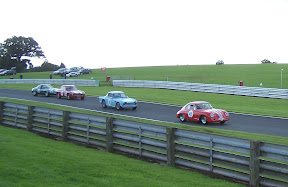
I’ll leave you with this picture from practice for the Guards Trophy race.

Friday, 6 June 2008

Word of the week: Doppelkupplungsgetriebe

I don’t speak German but there is something wonderfully clear and logical about it as a language. Even I could see how Doppelkupplungsgetriebe means double clutch gearbox. And how, you might ask, did I stumble upon this gem? It was in a Porsche press release detailing revisions to the 911 (direct fuel injection is the other major update). According to a knowledgeable friend it is pronounced:

"Doppel" is pronounced as the spelling suggests and means double.

"Kupplungs" is pronounced with the emphasis on the "Kup" part of the word – clutch, presumably.

"Getriebe" is pronounced "G'Treeber" – literally gear box?

So now you know!

Sunday, 30 March 2008

Of Instruments and Museums

Last weekend I visited my friend Simon, owner of the utterly charming MG Midget which I have mentioned before. Sadly, the Midget is not entirely well as you can read in Simon’s blog. But, component failure aside, the Midget did offer an interesting illustration of a phenomenon that is usually overlooked. Most cars, if they have a temperature gauge at all, only show you the engine temperature when the ignition is switched on. However, the Midget comes from a time before electrical transducers and has a mechanical temperature gauge, which shows the temperature even after you switch off the engine. When the engine stops the coolant pump and fan stop and the coolant just sits, picking up heat from the engine, with a mechanical temperature gauge you can actually watch the needle move towards the “H” marker. Wait long enough and the needle will drop back as the engine cools.

This weekend I visited the Coventry Transport Museum. As I may have said before, one of the reasons I like this museum is the way the exhibits are moved regularly so that there is always something new to see on each visit. The latest special exhibition is a celebration of anniversaries; the 60th anniversary of the Land Rover and Morris Minor and the 40th year of the Jaguar XJ6. It seems anniversaries only count if they are whole multiples of ten! There were some interesting substitutions among the exhibits. Using a Tygan Porsche 356 speedster recreation (developed, I believe from the famous Chesli Speedster) in place of a 1948 Porsche 356 was understandable, the Rover P4 in lieu of a 1958 P5 3-litre Rover was odd but the signage made it clear that it was only a temporary situation. No mention was made of the fact that the “Jaguar XJ6” was clearly an XJ12 series one (built in 1972-3 although Jaguar intended to launch the XJ with the V12 in ’68. Even more unusual was the presence of Daimler wheel trims (you would hope the museum could source the correct parts). Even so, it was a great exhibit even if it ignored the most meritorious 60-year old car, the 1948 Bristol 401.

Friday, 8 February 2008

I can’t wait for this…

The Porsche Panamera. Porsche’s 4-door saloon has had something of a stop-start development program. Initially I think it was intended to be a replacement for the 928. The economic climate of the early 1990s saw Porsche halt development – I think Porsche had some serious financial troubles of its own at the time. Now I think Porsche are one of (if not the) most profitable car companies in the world and they can afford to expand into new niche markets.

I’m not sure why the Porsche appeals as much as it does. The pictures in this week’s Autocar suggest that it is a handsome thing; long, low and sleek. Given Porsche’s reputation you can be sure it will be great to drive. I’d love to get my hands on one.

Wednesday, 30 January 2008

Why don’t I get gifts like that?

On 12th February Sandown Park racecourse will host an auction of classic cars. The auction is being run by Barons, which is celebrating ten years of car auctions. This is the first auction of the year and a tempting selection of cars is going under the hammer. If you fancy a convertible you could have one of two Jaguar E-Types, a Jaguar XJS Cabriolet, Porsche 944S2 Cabriolet and a charming 1939 Rover P2 open tourer. One exceptionally rare convertible is the ex-factory, RHD 1981 V8 Triumph TR8, one of just 18 RHD models built in 1980/81. Very few genuine TR8s exist outside the USA, except for pre-production examples, and this particular car was originally supplied to the Quality Control and Reliability Department of British Leyland – there must be a cheap joke to be made at the expense of BL. The TR8 is estimated to fetch £10,000-£12,000. There are plenty of other interesting lots but particularly a highly original 1969 Cooper S, described - rather poignantly - by the vendor as “an unwanted gift” (estimate £6,000-£9,000).

For more details go to www.barons-auctions.com

Thursday, 27 September 2007

A blast from the past

Going through the day’s press releases (it is a tough, dirty job but someone has to do it) I saw a name that I hadn’t heard in years. The name was ZF-Nivomat which is a self-levelling suspension strut which works using the movement of the suspension to maintain a constant ride height. I first heard about it in connection with early Porsche 911s (where it was the Boge Nivomat) but I suspect the first use was either on the Range Rover or the Ferrari 365GT 2+2.

The advantages of self-levelling suspension include more consistent handling and ride because the suspension is not bouncing along on the bump-stops. Tyres sit properly on the road, which helps road holding and reduces the danger of uneven tyre wear. Even a slight change in a vehicle’s angle of attack can upset the aerodynamic performance of the body; i.e. a heavy load in the back forces the back of the car down and the front up, increasing aerodynamic drag. Even the headlamps work more effectively because their aim is not upset.

ZF were keen to stress the advantage of a self-contained unit in terms of simplicity and economy. In my experience pneumatic suspension and Citroën-style oleo-pneumatic suspension offer advantages that the Nivomat strut cannot match. What cannot be done is to easily incorporate pneumatic suspension into vehicles not designed for it.