It seems that thieves have stolen the presses used to make the panels for the Bristol Blenheim. The presses, which weigh up to 30 tonnes, are thought to have been stolen for their scrap value – far less than the cost Bristol will incur replacing them.
What sort of world are we living in? You simply wouldn’t think anyone would consider stealing something like this. Maybe it will give Bristol the opportunity to develop a more shapely new body for the Blenheim range. There are those who would be happy if Bristol dusted off the tooling for the 411 range. The problem is the cost of developing and type approving a new body. I just hope it doesn’t mean the end of Bristol Cars.
Thursday, 5 July 2007


Wednesday, 4 July 2007
Thirty One Years Ago…
…as well as a heatwave and the American bicentennial celebrations July 1976 saw my arrival into the world. By way of a celebration I thought I’d have a look at the world of motoring in July ’76 as reported in CAR.
Lancia were promoting their Stratos, Citroën were making a fuss about the economy of their quirky cars (remember the Dyane and Ami?). The big news was the Chrysler Scamp, which the world would know as the Sunbeam. The Sunbeam didn’t go on sale until 1977 but July’s newcomers included the Renault 14 and Volvo 343 – not very stimulating. The Lancia Gamma was too new for its foibles to be discovered and the Lamborghini Silhouette seemed very stimulating indeed.
No issue of CAR in this period would be complete without a helping of supercars. Mel Nichols was dispatched to visit Maserati, De Tomaso, Lamborghini and Ferrari. After some difficult times in the fuel crisis things were looking up for the makers of exotic cars.
Almost every time I pick up an old magazine I find something that suggests the world hasn’t changed much in the passing years. So it was with an article on Formula 1:
And if you handicapped cars and opened up circuits to a bit more competition and a little less slowing down, assuring safety in other ways than by multiplying chicanes and other artificial curves and thus allowing more passing and more changes in race position…
How many times every year do people crave more overtaking in F1? What was the saying? Plus ça change...
Tuesday, 26 June 2007
C-Crosser makes me cross

I like Citroëns. I hope that is clear from my previous posts; as well as the C6 and my current BX I have fond memories of the C5 V6 (now sadly discontinued), the Visa and the iconic 2CV. The firm has blotted its copybook with the Xsara Picasso; an absurd vehicle good for nothing.
Now Citroën are jumping on the small 4x4-cum-mpv bandwagon with the C-Crosser, the result of a joint venture between PSA and Mitsubishi. I don’t blame Citroën for making what people want to buy. What I do object to, without quite knowing why, is the cloying emphasis on how kind it is to the environment.
Maybe if there was something identifiably Citroën about the C-Crosser it would be less annoying. Something minimal, lightweight, practical and go-anywhere - like an updated 2CV - would be brilliant. Sadly I don’t think the market wants such a car. Instead it wants soft-feel plastics, MP3 player compatibility, satellite navigation, two dozen airbags and low official CO2 figures for cheap road tax.
Citroën nearly went bust making the cars people should have wanted because the world was too dumb and too cautious to appreciate them. Sometimes, when I think of the Xsara Picasso and now the C-Crosser, I wonder if I wouldn’t be happier if the firm hadn’t survived the 1970s.
Saturday, 23 June 2007
thinktank at Millennium Point, Birmingham
I took a trip over to Birmingham this afternoon to visit thinktank, which (among other things) tells the history of Birmingham. The story is illustrated by the machinery used in and produced by the city’s industry. There is a great contrast between the giant steam pumping engines and the intricate button making machine.
The motor industry is remembered with some fine motorcycles from BSA and Brough Superior and some Austin cars – a Seven, Ruby and an original 1959 Mini (or Austin Se7en to be precise). The pioneer motor industry is illustrated by a license-built version of a Benz car. It seemed a missed opportunity not to credit Lanchester although there was a Lanchester prototype petrol-electric car, which I’d not heard of before.
The problem is that the museum’s strengths are also its weaknesses; there is so much in the museum that it sometimes seems to lack focus. Some more depth and detail on the exhibits would have been good – and this is where the museum’s website comes into its own - once you find your way around. Entry is quite expensive at £8.50 for an adult ticket but a family ticket at £25 represents quite good value and there is plenty to keep the whole family interested. Just don’t go on a weekend and expect to buy lunch – all the catering concessions appeared to be closed.
Thursday, 21 June 2007
Weird Tech: Lexus rear mounted radiator
I was going through Autocar and saw a piece on the Lexus LF-A. This is a super-coupé with a 500bhp V10 engine and 200mph performance. One of the more interesting features of the LF-A is the placement of the coolant radiators at the rear.
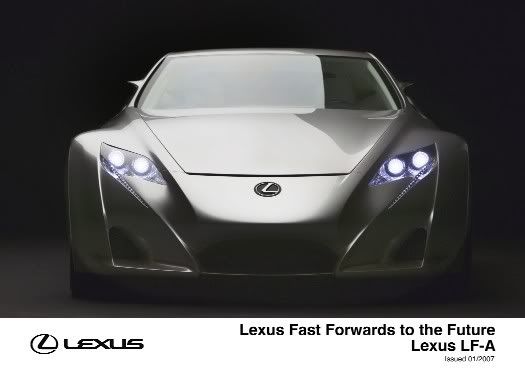
On mid or rear-engined cars this might not be unusual but the Lexus is a front mid-engined design. It seems to fly in the face of logic; the established convention for 110 years has been to put the radiator at the front of the car where it can receive the greatest flow of cooling air over its surface.
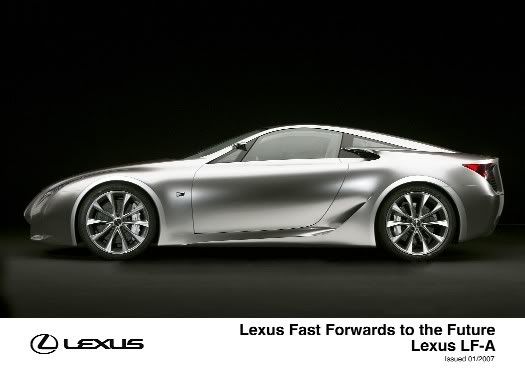
The idea isn’t as barking as you might think. Lexus claim to have done it to achieve the optimum weight distribution but it makes aerodynamic sense too. A car punches a big hole in the air at speed – a low-pressure wake similar to the wake following a boat as it moves through water. Air picks up heat as it passes through a car’s radiator, this makes the air expand. The heated air can therefore help to fill the low pressure wake behind the car.
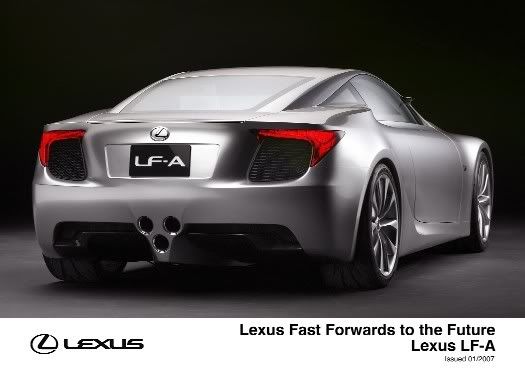
What might be the practical drawbacks? The boot opening on the concept car looks quite small; will it accommodate the regulation issue two golf bags? The radiators might cook the luggage or anyone standing loading or unloading the boot. Then again Lexus have a reputation for being thorough. By the time the LF-A goes on sale in the Autumn or 2008 I wouldn’t bet against the drawbacks being overcome.
On mid or rear-engined cars this might not be unusual but the Lexus is a front mid-engined design. It seems to fly in the face of logic; the established convention for 110 years has been to put the radiator at the front of the car where it can receive the greatest flow of cooling air over its surface.
The idea isn’t as barking as you might think. Lexus claim to have done it to achieve the optimum weight distribution but it makes aerodynamic sense too. A car punches a big hole in the air at speed – a low-pressure wake similar to the wake following a boat as it moves through water. Air picks up heat as it passes through a car’s radiator, this makes the air expand. The heated air can therefore help to fill the low pressure wake behind the car.
What might be the practical drawbacks? The boot opening on the concept car looks quite small; will it accommodate the regulation issue two golf bags? The radiators might cook the luggage or anyone standing loading or unloading the boot. Then again Lexus have a reputation for being thorough. By the time the LF-A goes on sale in the Autumn or 2008 I wouldn’t bet against the drawbacks being overcome.
Tuesday, 19 June 2007
Pet Peeves: “The indicator stalk is on the wrong side”
In a right hand drive car where the gear lever is to the driver’s left which is the correct side for the indicator stalk? Is the proper position for the indicator stalk going to be the same for a left hand drive car where the driver applies the right hand to the gear lever? Indicating and changing gear are often done in close succession so why make it difficult by expecting the same hand to do both?
Having spent plenty of time driving right-handed cars with indicators on the right and gear lever on the left – not just my Hondas but also my German-built Ford Granada coupé of 1977 vintage – I have to say that it is a better arrangement. Indeed it used to be the standard arrangement for British cars, which is why it annoys me when people claim that the arrangement is wrong. It annoys me even more when Autocar criticised the Vauxhall VXR8 (an Australian Holden, set up correctly for its native RHD market) and yet the Kia Cee’d was praised for the same arrangement.
It goes to show that the unfamiliar is too readily accepted as wrong, even by people who should know better.
Monday, 18 June 2007
Unsung Heroes: Dr Frederick Lanchester
I was talking to someone yesterday about my university days and admitted that although I knew the place as Coventry University it enjoyed a long and enviable reputation as Lanchester Polytechnic. This prompted the question of where, what or who was Lanchester? What a terrible situation, I’m sure most people could name a British playwright, composer, and a couple of great political and military leaders. How many could name a great British engineer? Lanchester Poly was named after one of the greatest (if not the greatest) and brightest men in British engineering history.
Dr Frederick Lanchester was a man of many and diverse interests. Born in 1868 Frederick began to study engineering at 14, by the age of 20 he was working for the Forward Gas Engine Company of Saltney, Birmingham. Lanchester’s interests were broad including philosophy, poetry and photography and much more. Powered flight was another of his interests, studying aerodynamic theory and building up a wealth of theoretical knowledge on the subject. If Lanchester had found a suitable internal combustion engine for a manned flying machine maybe he would never have turned his attention to the motor car.
It is probably fair to say that it was Lanchester’s proficiency with mathematics that made him such a great engineer. The prototype Lanchester car was introduced to the world in 1895 - and it was wholly British in its design unlike the German Daimler that was far better publicised a year later. Lanchester approached the problem from first principles, his understanding of suspension (both geometry and spring rates), structures, ergonomics and engine design were decades ahead of anyone else. The car was designed for mass production using standardised components without needing skilled labour.
Over time pressure from customers and shareholders diluted the purity of the cars bearing the Lanchester name. By 1931 the motorcycle and armaments firm BSA took control and Lanchester cars became little more than badge-engineered Daimlers (Daimler also being part of BSA). By 1956 Daimler phased out Lanchester cars and the name faded into obscurity.
Even where you might expect the Lanchester name to receive some recognition it languishes in obscurity. Visit the Museum of British Road Transport in Coventry and (as far as I could see) Lanchester has been erased from the history books. There is a monument in Birmingham to Lanchester’s pioneering car but how many people know it is there, how many know why?
Subscribe to:
Posts (Atom)
