Showing posts with label Torotrak. Show all posts

Wednesday, 9 January 2008

That’s annoying: missed the chance to see Xtrak

Transmission experts Xtrak are showing its wares at the Autosport International Engineering Show. As well as conventional racing transmissions Xtrak will be showing the Kinetic Energy Recovery System (KERS) based around the Torotrak variator. What a wonderful opportunity it would have been to study the system and maybe ask some intelligent questions and possibly even report back here with my findings.

Torotrak Xtrak

The problem is that the engineering show is on 10th and 11th January (according to Xtrak’s press release) and my work commitments mean I won’t be able to go along. If you would like to go; the engineering show runs from 10-11 January at the NEC, where the company will be exhibiting in Hall 19 on stand number E1038.

Friday, 14 December 2007

2008 Wish list part 2

No Gears

With the end of the year rapidly approaching you can be sure that lots of retrospective views of 2007 are being readied for publication. Rather than look back (which I will do) I would rather look forward and think about some of the cars I’d like to drive in the next year.

Once upon a time I owned a Ford Granada with an old-fashioned 3-speed automatic, which worked well but could have used another ratio. At the other extreme I once borrowed a Land Rover Defender which had ten possible gear ratios by combining a 5 speed gearbox with a low-ratio transfer box. On the road such low gearing was no use but on the whole you can never have too many gears. The greater number of gears the easier it is to keep the engine working either at speeds that offer the best mix of performance and economy (or the best of either if you prefer).

There comes a point where increasing the number of fixed gear ratios becomes impractical. Some Mercedes have 7-speed autos (and they seem to work well) while Lexus have an 8-speed transmission in the LS-series but how far can this strategy go? There must come a point where either the Van-Doorne or Torotrak transmissions, with steplessly variable gear ratios between fixed limits, become a smarter choice.

The logic behind such transmissions is persuasive, the engine turns at a steady speed and the transmission adjusts the ratio as the car accelerates. Eventually the transmission finds a point of equilibrium where the power supplied by the engine is matched by the power necessary to maintain a steady speed. At anything less than top speed the transmission will adjust so that the engine is turning as slowly as possible in order to maintain a steady cruising speed. Steady speeds are not really what I am interested in; I want to know how the transmissions cope with transitions, from cruising speed to acceleration, stopping and starting. A transmission without fixed ratio steps also promises to be an interesting aural experience; it is the one thing that nearly everyone dislikes about stepless transmissions and I want to see how I feel about it.

Friday, 30 November 2007

Quick Torotrak update

Another F1 team have been confirmed as taking out a license on the mechanical kinetic energy recovery system (KERS) for the 2009 season. One license was encouraging but two licenses are a clear sign that this is being taken seriously. Torotrak and its partners, Flybrid Systems and Xtrac, won the Professional MotorSport World “Engine Innovation of the Year Award" on 6 November 2007 in Cologne for the mechanical KERS.

All these developments are very promising, I just hope that involvement in Formula 1 don’t distract from getting a Torotrak transmission into a road car.

Tuesday, 2 October 2007

More Torotrak News

Another press announcement from Torotrak, this time slightly more relevant to the real world. A bus fitted with a prototype Torotrak IVT transmission demonstrated a 19% improvement in fuel economy compared with the standard 5-speed automatic transmission.

Photo Sharing and Video Hosting at Photobucket

The bus, an Optare Solo 60-seat vehicle, was fitted with a Torotrak IVT transmission and run through the Millbrook London Transport Bus cycle at the Millbrook test facility in Bedfordshire. It is an intensive stop-start cycle, which sounds like it should make the highest demands on any vehicle on the test.

Torotrak seem to think that with a purpose built transmission the gains could be even higher. Optare are, apparently, interested in putting the IVT into production. I would imagine that if the transmission can be incorporated at minimal additional cost the bus operators would be keen on the potential reduction in operating costs.

Tuesday, 25 September 2007

Torotrak update

The development of the Torotrak transmission has moved to the next stage. You may remember my enthusiasm when Torotrak announced that it was working with Xtrak on a drive system for Formula 1 cars (see July to refresh your memory). A major F1 team has become the first customer of a Torotrak-based kinetic energy recovery system.

The name of the customer has not been revealed but it is encouraging that progress from concept to application has been so swift. If only someone would use a Torotrak transmission in a car. Recovering energy that would be wasted under braking is very admirable. It is even better not to waste energy in the first place by running an engine at inefficient speeds.

Monday, 11 June 2007

Formula 1 in new technology shock (long post)

At the risk of sounding like a scene from The Life of Brian I have to ask,
“What has Formula 1 racing ever done for us?”
It is a valid question; I cannot think of any significant technological advance that to come from Formula 1 racing. Anyone who knows different is welcome to leave a comment by way of a correction.

There is always hope that one day Formula 1 will give the world of motoring something worthwhile; whether it is developing a new technology or embodying some desirable system. It may be that 2009 will be the year for good to be done, as Formula 1 cars incorporate a Torotrak transmission within the driveline.
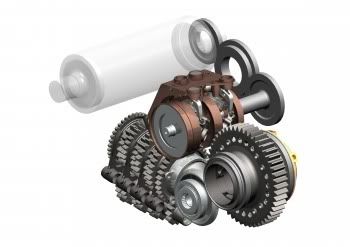
Photo Sharing and Video Hosting at Photobucket

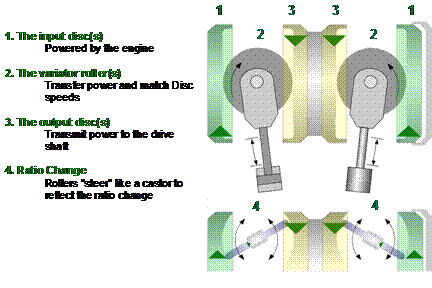
What is a Torotrak drive? It is a vehicle transmission that does not rely on fixed gear ratios but offers a stepless spread of gear ratios between fixed upper and lower limits. It is not a new idea; the basic principles can be traced back to the 1930s, when it was known as the Perbury drive, but it needed materials and particularly lubricants that were not developed until the 1980s in order to work properly. To understand how the Torotrak works imagine an axle with two flat-faced discs mounted so that both are free to spin independently. Between the faces of the disks - parallel to the axle - is a roller, fixed in space but free to spin, with the circumference of the roller touching both disks. If you turn one disk the other disk will rotate in the opposite direction at the same speed. The principle is similar to the differential gear but relying on friction rather than meshing gears to transmit drive.

If the roller was not parallel to the axle but at an angle so that the roller described a larger circle on the face of one disk than the other then the two disks will turn at different speeds and there will be a torque multiplication or reduction depending on which disk is driven. Flat-faced disks are no good for a variable ratio transmission so the opposing faces of the disks are machined with circular tracks of curved cross section. The curved tracks mean that the roller (usually the real Torotrak has 2 or 3 to reduce wear) remains in contact with the opposing faces as it is tilted. To reduce stress on the friction components the output disk has the curved tracks on both faces and is sandwiched between two sets of rollers and facing input disks. The Torotrak transmission also incorporates an epicyclic gear set and a couple of clutches (which can be engaged or disengaged but never slip). One of the input disks drives the planet carrier, the output disk drives the sunwheel and the annulus drives the car.

It would be too much to hope that the Torotrak was going to replace the conventional transmission of a Formula 1 racing car. There is no reason why it wouldn’t work; back in 1994 or 5 Williams tried a Van Doorne CVT drive in their then current F1 car and David Coulthard lapped Silverstone two seconds faster than he managed in an identical car with conventional transmission. Two seconds, thanks to the oft derided “rubber band” transmission was a considerable and worthwhile advantage. Before Williams could incorporate the transmission in a racing car the rules were changed and such transmissions were banned. The Torotrak would offer similar advantages and probably enjoys similar prohibition.

So how is the Torotrak to be incorporated? In some sort of effort to appeal to or appease the environmental movement Formula 1 want to be seen as more ecologically aware and incorporate energy saving devices into F1 cars. One idea is a kinetic energy recovery system (KERS) which is another old idea brought up to date. Rather than “wasting” energy converting kinetic energy to heat when braking, kinetic energy is used to spin up a flywheel which can be disconnected from the drive line and reconnected when the stored energy can be put to good use driving the car. It is an old idea because the Swiss used it in busses working in hilly areas; energy “gained” running down one hill could be stored and used to assist the climb up the next hill. By using a Torotrak drive rather than a simple clutch the energy sent to or recovered from the flywheel can be controlled with greater subtlety.

Torotrak PLC (the name of the British company owning the rights to the Torotrak drive) have granted a license to Xtrax, the transmission specialists, to incorporate the Torotrak drive in a gearbox with a KERS. The idea is to provide a more compact, lighter, more efficient means of energy storage than electrical batteries. The hope is that not only will racing teams adopt the technology but that it will find its way into road cars too.

My hope is that the publicity given to the Torotrak transmission as a result of the F1 association will act as a catalyst for someone to put a Torotrak transmission in a car that people can buy. Just imagine an automatic transmission that overcomes all the limitations of conventional automatics. With luxury cars adopting seven and eight speed automatics a transmission that can be in the right gear all the time by eschewing the established conventions of fixed ratios has to be a good idea.