Last post about the Oulton Park Gold Cup. I’m not much of a fan of motor racing but it is much better to see racing cars in action on the track rather than static in a museum. You do see some fine displays of driving skill as old racing cars generally have more power than they have roadholding or braking ability. This year some of the more prestigious cars stayed away because the Goodwood Revival was the following weekend. As a result there were no C or D-type Jaguars, no Listers, Ferraris or Corvettes, which was a disappointment given the high standard of entries in past years.
What was interesting was the difference in sound quality between the different engines. The sound of a 4 or 8 cylinder engine carries much more clearly than any six. Subjectively the loudest cars of the weekend were the Chevron sports cars and the Formula 5000 single-seaters. Formula 5000 was an interesting discipline, using Formula 1 chassis but with production-based 5-litre American V8 engines to keep costs down.
Favourite moments of the weekend included watching the historic Formula Junior cars and seeing both a Fiat 124 coupé and a BMW 328 (well, a Frazer-Nash BMW) in action. The Fiat is such a rare car because most examples rusted at a frightening rate – a shame because contemporary accounts rate it highly. As for the BMW, it was the most modern of the pre-war cars – no wonder so many people hold the 328 in high regard.
Thursday, 6 September 2007


Wednesday, 5 September 2007
Weekend fun 2
Over the bank holiday weekend I helped my mate Simon with his MG Midget. You can read about what we did in Simon’s blog, he tells the tale far better than I could and I don’t see the point in repeating what he has already said.
On Sunday we took the Midget to watch the motor racing at Oulton Park (of which more anon). Simon was kind enough to let me drive the Midget back to his house (about 25 miles, I think). If you are under any illusions about how good a driver you are an old car will soon shatter them. Old cars are less forgiving of mistakes; they can be annoyingly literal in the way they respond to the driver’s inputs. Just trying to pull away in the Midget was challenging. I’m more used to automatic transmission and the last manual car I drove had a very forgiving engine and clutch. The Midget has a short travel clutch pedal and the initial throttle response feels a little all or nothing. Simon even confessed that for the first week or two he had the car he either stalled or shot off as fast as the car could go.
Once on the move the clutch seemed far more user friendly – one reason I dislike most manual transmissions is un-necessarily long-travel clutch pedals. The gear lever had a pleasantly mechanical action and no spring-loading (a pet hate of mine in 4-speed gearboxes) allowing the lever to be moved quickly and freely in all directions. It all feels slightly frantic, the Midget is very low-geared so you get to top (4th) very quickly and at 50mph I think the rev counter was showing 3,000rpm. All the intermediate gears make their own distinctive noise and there is no synchromesh on first gear, which means it will crunch if you are in the habit of selecting first while the car is moving (time to brush up on neglected double declutching skills). Actually slowing to a stop needs quite a push – there is no brake servo and certainly no Citroën-style high pressure hydraulic system to lend a hand.
What delighted me about the Midget was the steering. Even with a smaller than standard steering wheel - a lovely, leather rimmed Moto Lita wheel – the steering isn’t heavy. There isn’t much self centring action, which is just what I like, just wind lock on or off as necessary and the Midget changes direction immediately. Not that the steering calls for much winding as it is pretty direct. It is just as well, the Midget is a snug fit and there is no room for flailing arms.
Driving the Midget was a rare delight. There is something about a simple, fun to drive car that is incredibly appealing. You can drive it hard without endangering your license and learn a lot in doing so. You can maintain it at home without needing specialist tools or any great skill and without breaking the bank. One day I think I’d like to own a car like this.
Thursday, 30 August 2007
Weekend fun
I took the opportunity to get away for the bank holiday weekend (25th – 27th), to visit friends and watch some motor racing. The weekend started with a trek up the M6, which invited a number of observations.
1. The M6 toll is a wonderful road, beautifully surfaced and it seems to attract well behaved drivers. Everyone keeps left, everyone seems content to travel at their own pace, no one crowds and no one seems aggressive.
2. The M6 toll should be extended north. The way the traffic stopped dead at the end of the toll section brings you back down to earth with a metaphorical bump. It seems that the M6 northbound cannot cope with the traffic from the toll road rejoining.
3. Congestion is self-limiting to a certain extent. The overhead signs warned of congestion for some distance surrounding the junction I needed. However, thanks to a little local knowledge I was able to come off a junction before the hold-up and follow an alternative route. When a road becomes known for slow or stationary traffic people will, wherever possible, modify their journey time or route to find a less congested alternative.
4. Our roads work very well. Even with the traffic as bad as it was my journey from Warwick to Urmston (not far from Old Trafford) took no more than two hours 15 minutes. That’s only 15 minutes more than I would expect the journey to take on a clear motorway.
My improvised route took me through the outskirts of Crewe. I know Bentley is based in Crewe so I was not surprised to see signs offering direction to the factory (although I always associate Rolls-Royce with Crewe even if BMW would rather I didn’t). What did astonish me was that the last of the signs I saw directed people to both the local recycling centre (rubbish dump) and Bentley. It seemed so incongruous that I was tempted to stop and photograph the sign, I suppose it illustrates the old saying, “where there’s muck, there’s brass”!
Wednesday, 22 August 2007
Britain in danger of running dry?
Apparently the number of petrol stations is at its lowest since 1912. With 150 forecourts having closed down already this year there is increasing concern about how difficult it might be to refuel in future.*
The pressures on retailers are understandable. For each pound (sterling not avoirdupois) of fuel sold something like 70-80 pence is tax revenue for the government which doesn't leave much money to cover the cost of the fuel, pay for the infrastructure and staff. No wonder petrol station shops all seem to be turning into mini supermarkets.
Urban petrol stations must also feel the pressure of high demand for land, forcing rents upwards. In the town wher I used to live I know two petrol station sites that are now residential flats.
Is there a solution? Probably not one single solution, more tax relief for petrol stations (especially those that are not associated with supermarkets) would help. Even more important is for us all to think about where we buy fuel. I could fill my car at the supermarket when I do my weekly shop but instead I support the petrol station in my village. It is more expensive but the loss of the only petrol station is more important than a few pounds in my pocket.
*Source: Retail Motor Industry Federation
It is very nice to be asked
One of the nicest things that happened to me recently was to be offered my own forum in a motoring forum run by a friend. The forum is for enthusiasts of post-war classics and is full of entertaining discussion - if you like old cars it is well worth a look.
I've also had someone else ask if they can re-use some of my blog articles on his web site. Nothing has happened yet because the site owners have other commitments. It is very encouraging to know that people read what I write and anything that helps me reach a wider audience has to be a good thing.
I've also had someone else ask if they can re-use some of my blog articles on his web site. Nothing has happened yet because the site owners have other commitments. It is very encouraging to know that people read what I write and anything that helps me reach a wider audience has to be a good thing.
Tuesday, 7 August 2007
Books Lately: Citroën 2CV by John Reynolds
My experience of car books suggests that most titles fall into one of two categories. There are thorough, in-depth studies carefully researched and lovingly written. Then there are books turned out as money-spinners. Some have titles like “Great Sports Cars” with a few performance specifications and glossy photos that look strangely familiar because you’ve seen them in half a dozen similar books before. Others will have a celebrity name on the cover and be smaller in format covering odd cars or bad cars, picking on the familiar whipping boys (Austin Allegro, Morris Marina, Reliant 3-wheeler etc).
John Reynolds’ history of the Citroën 2CV belongs firmly in the first group. First published in 1997, seven years after production of the 2CV ceased, with a 3rd edition published in 2005. It is a tribute to Mr Reynolds’ skill that you don’t need to be fanatical about the subject to enjoy the book. The background story, looking at the history of Citroën, the men responsible, the development story and even the way France changed in the 40 or so years all add colour to what might otherwise be a dry chronology of specification changes and model variants.
Of course details of the changes made as the 2CV was developed are recorded and the 2CV derivatives, the Dyane, Ami, Mehari and Bijou all receive fair coverage. Unlike plenty of one model books there is even a chapter devoted to the 2CV’s rivals. The way the book is written allows the reader to choose whether to read each chapter in order or to dip in and out depending on what captures the interest. There are even plenty of informative sidebars detailing areas of particular interest.
Even if you have little love for the 2CV (and it seems to be a love or loathe sort of car) but enjoy a good read this book is worth seeking out. It might not be packed full of glossy colour photographs (colour is confined to a couple of small sections) but there is plenty of intelligent content. Like the subject it covers the book is slightly quirky but has an undeniable appeal.
Friday, 20 July 2007
Goodbye Newport Pagnell
To many people I suspect Newport Pagnell is no more than a service station on the M1 motorway. To the car enthusiast Newport Pagnell is also the home of Aston Martin but as of 19th July it is no longer a car factory. The last Vanquish was driven off the production line in a ceremony attended by local dignitaries, Aston owners and employees. For the foreseeable future all Astons will be built at the purpose built facility at Gaydon in Warwickshire.
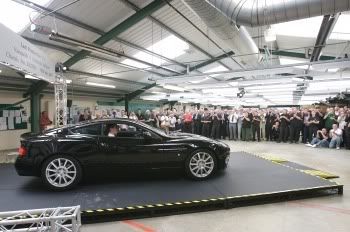
There is no cause for sadness, for one thing the Newport Pagnell site has been retained as a centre for servicing and restoring older cars. And, like most companies with a long history, Aston Martin has had more than one factory. The original factory was at Feltham in Middlesex (I think) and it was in 1953 that tractor magnate and then owner of Aston bought the Newport Pagnell site with full production starting in 1958.
The closure does mean that both of the car factories I’ve visited have closed (the other was Jaguar’s Browns Lane plant). It was back when the DB7 was current but before the Virage and Vantage had been phased out. I was given a tour by the late Roger Stowers, the company historian and archivist. Whatever you thought of the old V-series cars you had to respect the craftsmanship and love with which they were assembled. Who could believe the current, thoroughly modern Astons are any relation to the magnificent old dinosaurs the company used to make? I wonder if the Gaydon factory will enjoy 50 years of productivity.
Subscribe to:
Posts (Atom)
