
Showing posts with label roadster. Show all posts
Showing posts with label roadster. Show all posts
Tuesday, 10 June 2008
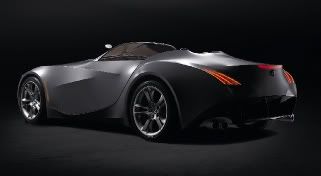
BMW GINA Light concept car
Just a brief entry as I've got to do a full write up about BMW's latest concept car. What I wanted to say here, where I can afford to be less objective and more opinionated, is how much I love it. Not only does it challenge lots of preconceived ideas about how a car should be made but the thinking behind it promises to challenge the attitude that "we've always done it this way". Of course it helps that the concept car is beautiful, a classical roadster with the engine at the front under a long bonnet. Hopefully all future BMWs will look as good as this.


Wednesday, 7 November 2007
Roadsters Remembered: Honda S2000
With summer well and truly over it seemed time to bring this series to a conclusion. I wanted to save the best until last and the Honda is my favourite of all the roadsters I’ve driven. From the moment I settled behind the wheel I felt at home, the cabin was close fitting without being cramped. The pedals, wheel and gear lever were all perfectly located and the digital instruments were a model of clarity.
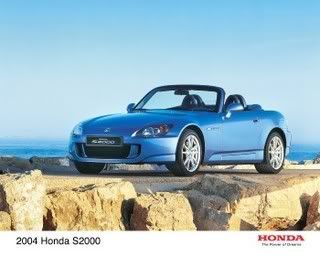
Going slowly the S2000 was as easy to drive as any Honda Civic. Over serious bumps the body felt amazingly rigid, maybe the ride was a little on the firm side but it was controlled rather than harsh. The engine pulled freely and strongly with increasing vigour as the revs increased. The steering felt linear in its weighting and response, the gear lever had a beautiful action and even at 100mph I was perfectly comfortable with the roof lowered.
I have enjoyed all the open cars I have driven. Any of them would serve admirably as occasional, fair weather transport. Only the S2000 felt like a serious car that could be used everyday. It might not be cheap but I’m convinced the S2000 is worth every penny.
Going slowly the S2000 was as easy to drive as any Honda Civic. Over serious bumps the body felt amazingly rigid, maybe the ride was a little on the firm side but it was controlled rather than harsh. The engine pulled freely and strongly with increasing vigour as the revs increased. The steering felt linear in its weighting and response, the gear lever had a beautiful action and even at 100mph I was perfectly comfortable with the roof lowered.
I have enjoyed all the open cars I have driven. Any of them would serve admirably as occasional, fair weather transport. Only the S2000 felt like a serious car that could be used everyday. It might not be cheap but I’m convinced the S2000 is worth every penny.
Wednesday, 19 September 2007
Roadsters Remembered 4: Vauxhall VX220 turbo
Sometimes, for no good reason, you don’t get off to the best start with a car. With the Vauxhall it was difficult to get any sort of start. I put the key in, turned it and nothing. The sort of nothing familiar to owners of old wrecks when the solenoid on the starter motor fails. No one told me the VX had a starter button; the button itself was not labelled and looked like an innocent piece of interior trim.
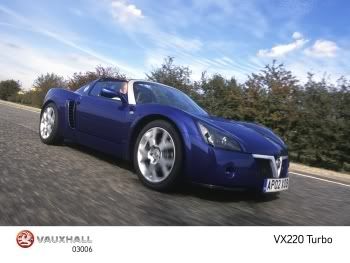
The first thing I noticed when I started driving was steering like an old Mini, the feeling of a lightweight car with unassisted steering and wide tyres. Power assisted steering is so common the feeling is denied to most drivers. It felt reassuring, an indication that messages between the front wheels and the driver’s fingers were clearly communicated. The gear lever also felt slightly old-fashioned with plenty of movement between each position and a slightly loose feeling. It felt as though it was taken directly from a front-wheel drive hatchback – which probably wasn’t far from the truth.
If the sensations were old fashioned the performance was right up to date. Strong acceleration, surefooted cornering and even a decent ride; it was difficult to fault the way the VX went. There was something about the engine and transmission that made the performance a little lumpy, a feeling of thrust – pause – thrust in each gear. Maybe familiarity would improve matters, or perhaps the idea was to make the performance feel more dramatic. A smooth, almost seamless flow of acceleration would have done more to impress me. Closer gear ratios would help as would a non-turbocharged engine. Maybe I would prefer a non-turbocharged VX220.
There isn’t anything else to criticise about the VX, it is a bit basic but it is supposed to be and I don’t know how effective the hood is at keeping out the rain. You would need to be keen to use one everyday but the VX220 does offer many of the sensations of an old car with the convenience of modern hardware.
The first thing I noticed when I started driving was steering like an old Mini, the feeling of a lightweight car with unassisted steering and wide tyres. Power assisted steering is so common the feeling is denied to most drivers. It felt reassuring, an indication that messages between the front wheels and the driver’s fingers were clearly communicated. The gear lever also felt slightly old-fashioned with plenty of movement between each position and a slightly loose feeling. It felt as though it was taken directly from a front-wheel drive hatchback – which probably wasn’t far from the truth.
If the sensations were old fashioned the performance was right up to date. Strong acceleration, surefooted cornering and even a decent ride; it was difficult to fault the way the VX went. There was something about the engine and transmission that made the performance a little lumpy, a feeling of thrust – pause – thrust in each gear. Maybe familiarity would improve matters, or perhaps the idea was to make the performance feel more dramatic. A smooth, almost seamless flow of acceleration would have done more to impress me. Closer gear ratios would help as would a non-turbocharged engine. Maybe I would prefer a non-turbocharged VX220.
There isn’t anything else to criticise about the VX, it is a bit basic but it is supposed to be and I don’t know how effective the hood is at keeping out the rain. You would need to be keen to use one everyday but the VX220 does offer many of the sensations of an old car with the convenience of modern hardware.
Saturday, 2 June 2007
Roadsters Remembered Mazda MX5 mk2
The original MX5 of 1989 pretty much single-handedly revived interest in the open 2-seat sports car. British Leland ceased production of the MGB in 1980 and the closest thing to a mass-market roadster was the Reliant Scimitar SS1, launched in 1984. Angular styling and odd proportions robbed the Scimitar of mass market appeal (although I think it looks quite smart). Perhaps affordable mid-engined cars in the mould of the Fiat X1/9 and Toyota MR2 should have assumed the role of the popular sports car but it doesn’t seem to have happened. Instead the majority of modern roadsters have adopted the traditional front-engined rear-wheel drive layout.
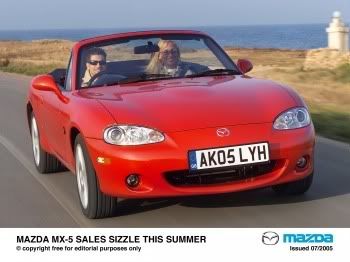
It was 9 years before the MX5 was updated, which must say something for how right it was. The second generation MX5 was received with nearly as much enthusiasm as the first. Although I never drove the original MX5 I was keen to try the second one when the opportunity presented itself. That opportunity coincided with the chance to drive 2 other roadsters, the Honda S2000 and the Vauxhall VX220 turbo (which I will return to); it seemed sensible to use the Mazda as a yardstick.
Trying to describe the MX5 is difficult; it was an appealing and light-hearted car. It enjoyed that trait unique to the best Japanese cars of being light and easy to drive without being vague or sloppy. As a result it felt good and yet it is nearly impossible to describe any single aspect. That is probably because there is nothing about the steering, the engine, the gearbox or the ride that is non-linear in behaviour. I’m sure it is the lack of exaggerated response that makes the MX5 such a nice car to drive. For everyone else the smart styling and Japanese reliability mean there is no reason not to buy the sports car you always promised yourself.
It was 9 years before the MX5 was updated, which must say something for how right it was. The second generation MX5 was received with nearly as much enthusiasm as the first. Although I never drove the original MX5 I was keen to try the second one when the opportunity presented itself. That opportunity coincided with the chance to drive 2 other roadsters, the Honda S2000 and the Vauxhall VX220 turbo (which I will return to); it seemed sensible to use the Mazda as a yardstick.
Trying to describe the MX5 is difficult; it was an appealing and light-hearted car. It enjoyed that trait unique to the best Japanese cars of being light and easy to drive without being vague or sloppy. As a result it felt good and yet it is nearly impossible to describe any single aspect. That is probably because there is nothing about the steering, the engine, the gearbox or the ride that is non-linear in behaviour. I’m sure it is the lack of exaggerated response that makes the MX5 such a nice car to drive. For everyone else the smart styling and Japanese reliability mean there is no reason not to buy the sports car you always promised yourself.
Wednesday, 16 May 2007
Roadsters Remembered #1 MG MGB
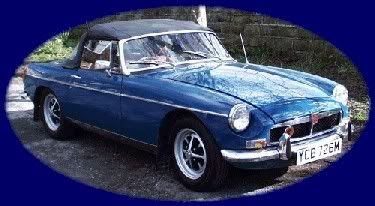
The British climate is not the most conducive to driving open cars but with summer on its way I’ve been thinking about all the open 2-seat cars I’ve driven. The MGB is more than just a car – it is practically a national institution. There is something about the B’s simplicity, size and good looks that give it enduring appeal.
There is no better way to see how cars have changed than to drive one that is 40 years old. It is a physical car; the steering is heavy, the pedals demand firm inputs, the ride is restless and there is persistent background noise. You get used to carrying a can of WD40 to spray on the engine when the weather is wet – otherwise it won’t start – and the fact that the rain will find somewhere to come round the edge of the convertible roof.
Old virtues also emerge, the steering is also more direct than a new car, the gear lever feels pleasantly mechanical and there is overdrive to get used to. Overdrive was a way to give 4-speed cars a 5th gear for relaxed high-speed cruising and on the B was operated by a switch on the dashboard. When it worked there was something wonderful about flicking a switch to change gear – but there was no guarantee of an instant response or even any response at all. Overdrive units have a tendency to get sticky with age.
What the MG needs to be enjoyed at its best are the right kind of roads; lightly trafficked, country roads. Do not try to drive as quickly as possible, you will expend a lot of effort for little reward and it is better to relax, enjoy the view and the beat of the exhaust. Repeat the exercise at night; the view may be diminished but the sounds and smells are enhanced. If you are used to closed cars it lends a whole new dimension to driving.
You may not want to do it all the time but driving an MGB is something you should try at least once.
Subscribe to:
Posts (Atom)
