Going through the day’s press releases (it is a tough, dirty job but someone has to do it) I saw a name that I hadn’t heard in years. The name was ZF-Nivomat which is a self-levelling suspension strut which works using the movement of the suspension to maintain a constant ride height. I first heard about it in connection with early Porsche 911s (where it was the Boge Nivomat) but I suspect the first use was either on the Range Rover or the Ferrari 365GT 2+2.
The advantages of self-levelling suspension include more consistent handling and ride because the suspension is not bouncing along on the bump-stops. Tyres sit properly on the road, which helps road holding and reduces the danger of uneven tyre wear. Even a slight change in a vehicle’s angle of attack can upset the aerodynamic performance of the body; i.e. a heavy load in the back forces the back of the car down and the front up, increasing aerodynamic drag. Even the headlamps work more effectively because their aim is not upset.
ZF were keen to stress the advantage of a self-contained unit in terms of simplicity and economy. In my experience pneumatic suspension and Citroën-style oleo-pneumatic suspension offer advantages that the Nivomat strut cannot match. What cannot be done is to easily incorporate pneumatic suspension into vehicles not designed for it.
Thursday, 27 September 2007


Wednesday, 26 September 2007
Thoughts on this week’s Autocar
If I understand these things correctly a blog should be topical and updated regularly. Being topical isn’t necessary, I suppose, but it is interesting that the more I write the more ideas come for future entries – which is great for ensuring a steady stream of entries.
Every week I read Autocar, it is a good way to get an overview of the important motor industry news and it is a good read to boot. It is interesting to see what stands out. In the 2007 Green Grand Prix a passing mention is made of Mercedes’ BlueTec low emissions engines. It is interesting that Mercedes have focused on reducing hydrocarbon, nitrous oxides and particulates at the expense of slightly higher CO2 emissions. Because that approach isn’t compatible with a CO2 based tax system BlueTec isn’t coming to the UK. So is an obsession with carbon dioxide actually harming the environment by increasing emissions of other pollutants?
Every week I read Autocar, it is a good way to get an overview of the important motor industry news and it is a good read to boot. It is interesting to see what stands out. In the 2007 Green Grand Prix a passing mention is made of Mercedes’ BlueTec low emissions engines. It is interesting that Mercedes have focused on reducing hydrocarbon, nitrous oxides and particulates at the expense of slightly higher CO2 emissions. Because that approach isn’t compatible with a CO2 based tax system BlueTec isn’t coming to the UK. So is an obsession with carbon dioxide actually harming the environment by increasing emissions of other pollutants?
Tuesday, 25 September 2007
Torotrak update
The development of the Torotrak transmission has moved to the next stage. You may remember my enthusiasm when Torotrak announced that it was working with Xtrak on a drive system for Formula 1 cars (see July to refresh your memory). A major F1 team has become the first customer of a Torotrak-based kinetic energy recovery system.
The name of the customer has not been revealed but it is encouraging that progress from concept to application has been so swift. If only someone would use a Torotrak transmission in a car. Recovering energy that would be wasted under braking is very admirable. It is even better not to waste energy in the first place by running an engine at inefficient speeds.
The name of the customer has not been revealed but it is encouraging that progress from concept to application has been so swift. If only someone would use a Torotrak transmission in a car. Recovering energy that would be wasted under braking is very admirable. It is even better not to waste energy in the first place by running an engine at inefficient speeds.
Wednesday, 19 September 2007
Roadsters Remembered 4: Vauxhall VX220 turbo
Sometimes, for no good reason, you don’t get off to the best start with a car. With the Vauxhall it was difficult to get any sort of start. I put the key in, turned it and nothing. The sort of nothing familiar to owners of old wrecks when the solenoid on the starter motor fails. No one told me the VX had a starter button; the button itself was not labelled and looked like an innocent piece of interior trim.
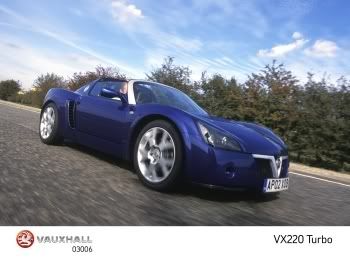
The first thing I noticed when I started driving was steering like an old Mini, the feeling of a lightweight car with unassisted steering and wide tyres. Power assisted steering is so common the feeling is denied to most drivers. It felt reassuring, an indication that messages between the front wheels and the driver’s fingers were clearly communicated. The gear lever also felt slightly old-fashioned with plenty of movement between each position and a slightly loose feeling. It felt as though it was taken directly from a front-wheel drive hatchback – which probably wasn’t far from the truth.
If the sensations were old fashioned the performance was right up to date. Strong acceleration, surefooted cornering and even a decent ride; it was difficult to fault the way the VX went. There was something about the engine and transmission that made the performance a little lumpy, a feeling of thrust – pause – thrust in each gear. Maybe familiarity would improve matters, or perhaps the idea was to make the performance feel more dramatic. A smooth, almost seamless flow of acceleration would have done more to impress me. Closer gear ratios would help as would a non-turbocharged engine. Maybe I would prefer a non-turbocharged VX220.
There isn’t anything else to criticise about the VX, it is a bit basic but it is supposed to be and I don’t know how effective the hood is at keeping out the rain. You would need to be keen to use one everyday but the VX220 does offer many of the sensations of an old car with the convenience of modern hardware.
Sunday, 16 September 2007
It is nice to be asked #2
A big thank you to Simon and Mike of Street-Car.net who asked if they could use some of these posts on their site. Street-Car has an established, international readership so it should bring me welcome additional exposure. There is also plenty of lively discussion, automotive news and car specification data. Go, have a look and maybe join in.
Wednesday, 12 September 2007
Green Driving
The environmentalists are at it again. The world is under threat because some people choose to do 80 on the motorway rather than the legally permitted 70. This apparently produces a third more CO2 which will cause the Earth to warm up until it can no longer support human life. Or it’ll cause more extreme weather and hot places will get hotter while cool places get cooler. The more you listen the clearer it becomes that no-one knows what will happen but everyone is happy to predict doom and gloom.
None of the news reporters, none of the lobbyists, no one at all has paused to consider what they are actually saying. Man made emissions account for a small amount of atmospheric CO2. Of that the UK is responsible for a tiny percentage. Transport might account for a large proportion of the UK’s carbon dioxide but remember transport is more than just cars and how much CO2 can be accounted for by cars exceeding the motorway speed limit as opposed to crawling through towns? The term “a drop in the ocean” barely seems adequate to express the magnitude the saving if the environmentalists get their way.
Anyone who makes long motorway journeys must have noticed that they are about the most economical (in terms of mpg) car journeys while driving in town use the most fuel. Where safe I treat the motorway limit as a guideline rather than an absolute rule (as most do). On long journeys it saves time, which is far more important than saving money. The amount of fuel needed to maintain steady motorway speeds is tiny even if doing 80mph produces a third more carbon dioxide than 70 (itself an unsound, one size fits all approximation) it is a third more of a tiny number.
Rather than trying to slow down motorway traffic the campaigners would be better advised to look elsewhere to make changes. If fuel consumption is at its worst in urban environments why not look at what can be done there to improve matters? Rather than having traffic stationary, burning fuel and going nowhere, try to keep the traffic flowing. Urban air quality would improve, people would be less frustrated, fewer precious resources (fuel and time in particular) would be wasted and less CO2 would be released into the atmosphere. Steve Cropley said much the same thing in this week’s Autocar. Of course if you want to stick to 70mph on the motorway feel free; just remember to keep left so other traffic can flow freely past.
Monday, 10 September 2007
Coventry Festival of Motoring
Every year the city of Coventry celebrates its association with the motor industry with a major classic car event. It is probably unique amongst classic car shows for two reasons; 1- participants have to pay an entry fee while members of the public can view for free; and 2- this is more than just neatly polished old cars in a park where people admire them, there is a sedate run through the Warwickshire countryside.
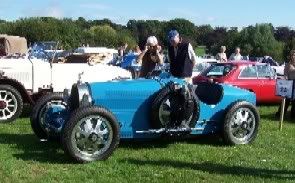
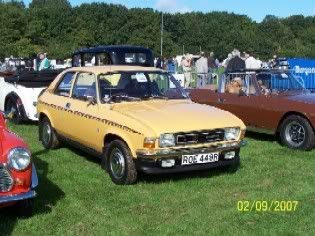
This year I knew someone who was taking part so it seemed like the perfect excuse to see what was going on. According to the web site some 540 vehicles took part including commercial vehicles, a couple of Green Goddess fire engines, lots of motorcycles and, of course, plenty of cars. The oldest vehicle on the run was a 1902 Wolseley and the newest a charity-sponsored Lexus IS200 driven by local news presenter Ashley Blake. Famous names like Rolls-Royce, Bentley and Bugatti were represented along side the familiar, household names of Triumph, Austin, Hillman, Ford, Volkswagen and many more.
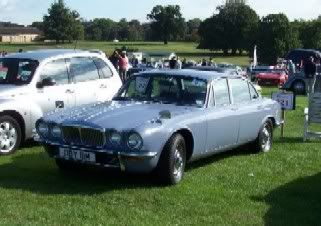
I was invited to join in, travelling in the comfortable leather passenger seat of a Series 2 Daimler Double Six. There was plenty to see, lots of villages on the route had put up bunting and young and old alike were out waving at the passing cars. The organisers also split the run into two groups, both following the same route but in opposite directions so participants could see and wave to one another. It was great fun and I hope I can take part in an old car of my own one day.
This year I knew someone who was taking part so it seemed like the perfect excuse to see what was going on. According to the web site some 540 vehicles took part including commercial vehicles, a couple of Green Goddess fire engines, lots of motorcycles and, of course, plenty of cars. The oldest vehicle on the run was a 1902 Wolseley and the newest a charity-sponsored Lexus IS200 driven by local news presenter Ashley Blake. Famous names like Rolls-Royce, Bentley and Bugatti were represented along side the familiar, household names of Triumph, Austin, Hillman, Ford, Volkswagen and many more.
I was invited to join in, travelling in the comfortable leather passenger seat of a Series 2 Daimler Double Six. There was plenty to see, lots of villages on the route had put up bunting and young and old alike were out waving at the passing cars. The organisers also split the run into two groups, both following the same route but in opposite directions so participants could see and wave to one another. It was great fun and I hope I can take part in an old car of my own one day.
Subscribe to:
Posts (Atom)
